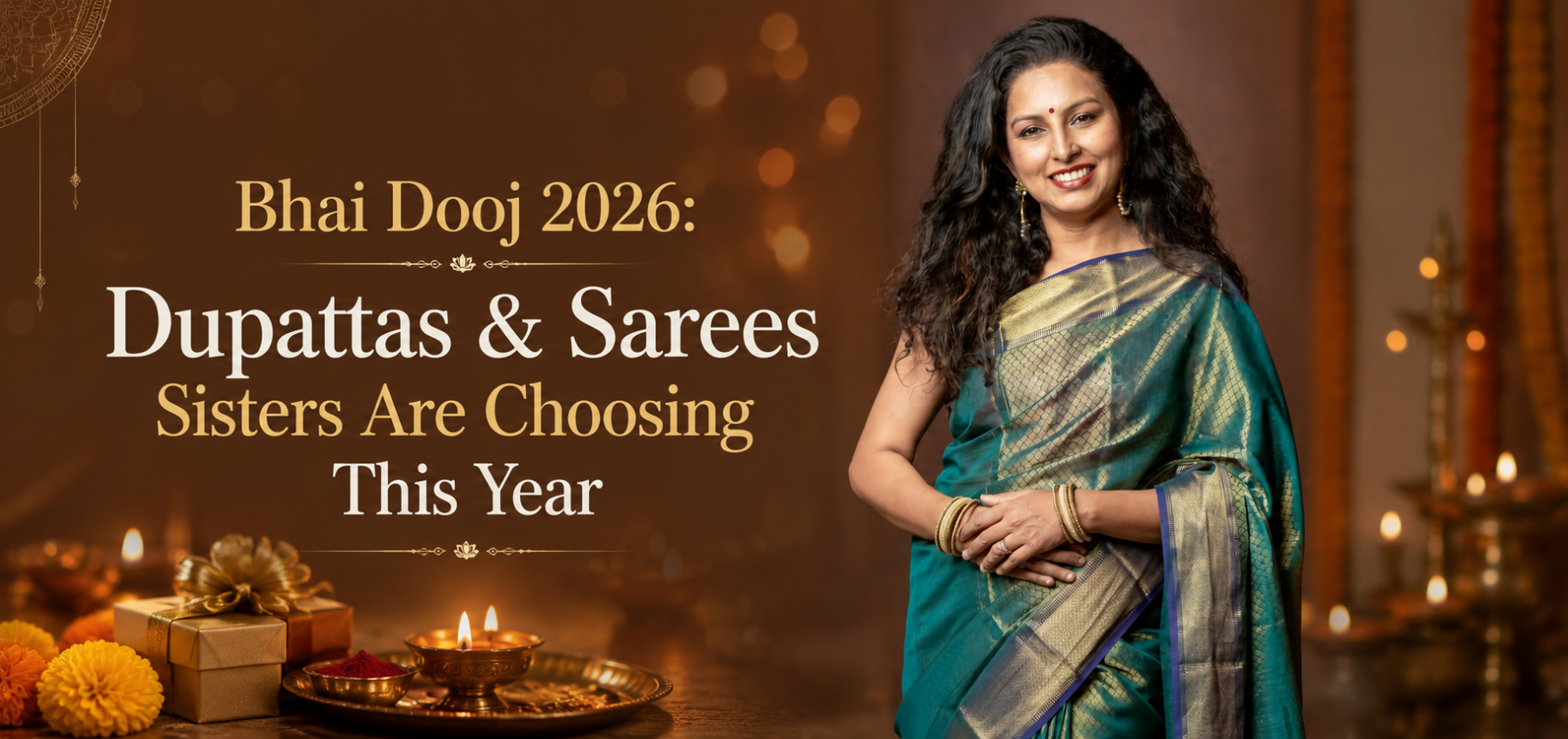
Bhai Dooj 2026: Dupattas & Sarees Sisters Are Choosing This Year
Bhai Dooj 2026 falls close on the heels of Diwali, and for most sisters across India, the outfit gets decided almost as early as the gifts. Among the most searched Bhai Dooj outfit ideas this season are handwoven sarees and dupattas that carry a festive weight without leaning on heavy embellishment. This shift is visible in what's selling — fabrics with texture and history, not just shine.
What is Bhai Dooj? Bhai Dooj is a Hindu festival celebrated two days after Diwali, where sisters perform a tilak ceremony for their brothers' wellbeing and long life, and brothers, in turn, offer gifts. It falls on the second day of the bright fortnight (Shukla Paksha) of the Kartik month, typically in late October or November.
When Is Bhai Dooj in 2026?
Bhai Dooj 2026 is expected to be observed in the first half of November, two days after Diwali, following the Kartik Shukla Paksha Dwitiya tithi. Regional names for the same festival include Bhau Beej in Maharashtra, Bhai Phota in Bengal, and Yama Dwitiya in parts of North India, though the ritual core — the tilak, the aarti, and the shared meal — stays consistent nationwide.
Bhai Dooj Outfit Ideas Sisters Are Searching For This Year
This year's Bhai Dooj outfit ideas lean toward handcrafted sarees in mid-weight silks and cottons, paired with dupattas that can double up for other festive days in the Diwali-to-Bhai Dooj window. The pattern shows up clearly in search behaviour and in what sisters are actually adding to cart — fewer sequins, more weave.
Sarees Leading the Search Trend
Three saree categories dominate this year's shortlist: Maheshwari silk for its light drape, Chanderi for its sheer festive shimmer, and Batik print for sisters who want a quieter, artisanal look. Each of these is suited to a late-morning tilak ceremony, where comfort across a few hours matters as much as appearance.
Dupattas as the Flexible Choice
Not every sister wants a full saree for Bhai Dooj, especially when the day includes travel between homes. A well-chosen dupatta over a kurta or lehenga does the same festive job with far less effort, and it's a piece that gets reused through the rest of the wedding and festival season.
Saree Styles Sisters Are Choosing This Year: A Quick Comparison
Here's how the leading saree choices for Bhai Dooj 2026 compare, based on fabric weight, occasion fit, and upkeep:
- Maheshwari Silk: Lightweight cotton-silk blend, originally woven in Maheshwar, Madhya Pradesh, since the 18th century under Rani Ahilyabai Holkar's patronage. Best for daytime tilak ceremonies; easy to drape and low-maintenance.
- Chanderi Silk: Sheer, glossy texture from Chanderi, Madhya Pradesh, woven with silk and zari or cotton yarn. Suited to sisters who want visible shine without the weight of a heavier Banarasi.
- Batik Print: Wax-resist hand-dyeing technique, traditionally on cotton or silk base, giving irregular, artisanal motifs. Chosen by sisters who prefer understated festive dressing over heavy zari work.
- Tissue Silk: Fine silk woven with a metallic thread running through the fabric, giving a translucent, glowing finish. Popular for evening Bhai Dooj gatherings where lighting favours the fabric's shimmer.
- Handmade Sarees (block-print, hand-embroidered): No two pieces are identical since each is finished by hand; small irregularities are part of the craft, not a flaw. Favoured by sisters buying for the gifting angle — a saree with a story attached.
Anyone comparing weaves closely will find maheshwari silk sarees online a practical starting point for a daytime Bhai Dooj look, since the fabric holds pleats well without needing constant adjustment through a long ceremony.
Dupatta Choices That Complete the Bhai Dooj Look
A dupatta carries almost as much festive weight as the outfit underneath it, and this year sisters are picking pieces that work for more than one occasion. Two categories stand out for Bhai Dooj specifically.
Chanderi Silk Dupatta
A Chanderi silk dupatta pairs naturally with a plain or lightly worked kurta, letting the dupatta's zari border do the festive signalling. It's also light enough to wear over a saree blouse for sisters who want an extra layer of drape without added weight.
Handwoven Dupatta
A handwoven dupatta made on a pit loom or frame loom carries slight thread irregularities that machine-made fabric can't replicate — the mark of a human hand at the loom, not a defect to overlook. These pieces tend to outlast a single festive season, which makes them a repeat pick for sisters buying for both Bhai Dooj and the wedding season that typically follows.
How to Style a Bhai Dooj Outfit: Step by Step
Getting the look right for a morning tilak ceremony doesn't need to be complicated. Here's a simple sequence that works across most handwoven sarees and dupattas:
- Pick the base first. Decide between a saree or a kurta-dupatta combination based on how much of the day involves travel.
- Match fabric to time of day. Cotton-silk blends like Maheshwari suit morning ceremonies; tissue silk suits evening gatherings where light catches the sheen.
- Keep jewellery minimal on a handwoven piece. The weave itself is the detail — one statement piece (jhumkas or a single necklace) is usually enough.
- Choose footwear for comfort, not just colour-matching. Tilak ceremonies often involve sitting on the floor, so flat juttis work better than heels.
- Carry a small bag, not a clutch. Gift exchanges and phone use through the day make a cross-body or potli bag more practical.
Why Handcrafted Fabrics Are Trending for Bhai Dooj 2026
The shift toward handcrafted sarees and dupattas isn't only aesthetic — it reflects a broader move toward slow fashion among festive shoppers. Sisters increasingly ask where a fabric was woven and by whom, not just how it looks in a photo.
At the loom level, a single Maheshwari or Chanderi saree can take anywhere from three days to over a week to weave, depending on the complexity of the border and pallu work. Natural dyes, where used, are prepared in small batches, which is part of why colour tone can vary slightly between two sarees from the same weaver — a detail that's often flagged as a feature, not an inconsistency, by buyers who understand handloom production.
For sisters who want a saree that's entirely one-of-a-kind rather than one of a production run, handmade sarees online are worth browsing specifically for Bhai Dooj gifting, since each piece is finished individually rather than replicated at scale.
Batik Print and Tissue Silk: The Quieter Bhai Dooj Picks
Not every sister wants a saree that announces itself from across the room, and this is where batik print and tissue silk sarees have found steady demand this season. Batik's wax-resist process leaves soft, irregular patterns that read as understated rather than muted, while tissue silk's metallic thread gives a glow that photographs well without needing bright colour.
Sisters shopping specifically within this quieter register can look at batik print sarees online for daytime wear, or tissue silk sarees online for an evening Bhai Dooj gathering where the fabric's sheen has more room to catch the light.
Bhai Dooj Outfit Ideas: Final Checklist Before You Buy
Before finalising a saree or dupatta for Bhai Dooj 2026, it helps to run through a short checklist rather than shopping on colour alone.
- Confirm the ceremony's setting — home floor seating calls for lighter, easy-drape fabrics over stiff, heavy ones.
- Check the blouse timeline separately if buying a saree that needs stitching; handwoven pieces often arrive unstitched.
- Ask about the weaving technique and origin — Maheshwari, Chanderi, and batik each carry a distinct regional craft history worth knowing before you buy.
- Factor in reuse. A dupatta or saree bought for Bhai Dooj typically gets worn again through the wedding season that follows in winter.
Frequently Asked Questions
What should sisters wear for Bhai Dooj 2026?
Most sisters are choosing handwoven sarees in Maheshwari or Chanderi silk, or a kurta paired with a handwoven or Chanderi silk dupatta. The choice usually comes down to how much of the day involves sitting for the tilak ceremony versus moving between homes.
Which fabric is best for a daytime Bhai Dooj ceremony?
Maheshwari silk is a strong choice for daytime ceremonies because it's lightweight, holds pleats well, and doesn't add heat or bulk during a long tilak ritual. Batik print cotton sarees are a good alternative for a quieter, low-maintenance look.
Is a dupatta enough for Bhai Dooj, or is a saree necessary?
A dupatta is entirely acceptable for Bhai Dooj, especially paired with a kurta or lehenga, and many sisters prefer it for the ease of movement it allows. A saree tends to be chosen when the day includes a larger family gathering or photographs are a priority.
What makes handwoven sarees different from machine-made ones?
Handwoven sarees are made on pit or frame looms by artisans, which means small thread irregularities and slight colour variation are part of the fabric rather than a defect. Machine-made sarees are more uniform but don't carry the same craft history or one-of-a-kind quality.
How far in advance should Bhai Dooj outfits be ordered?
Since Bhai Dooj falls right after Diwali, it's advisable to order handwoven sarees or dupattas at least two to three weeks in advance, particularly if the saree needs blouse stitching. Handcrafted pieces also take longer to restock once a design sells out.
In short: Bhai Dooj 2026 outfit choices are leaning firmly toward handcrafted, handwoven sarees and dupattas — Maheshwari and Chanderi silk for daytime ceremonies, tissue silk and batik print for quieter or evening looks, and handwoven dupattas as the flexible, reusable option. The common thread across every choice is fabric with a traceable craft history, not just festive shine.
-
Which Saree Should I Wear? Easy Choices for Weddings, Office, Festivals & Everyday
September 17th, 2026 -
 August 25th, 2026
 -
What to Wear for Ganesh Chaturthi: Saree Colours and Styling Guide
August 24th, 2026 -
 August 24th, 2026