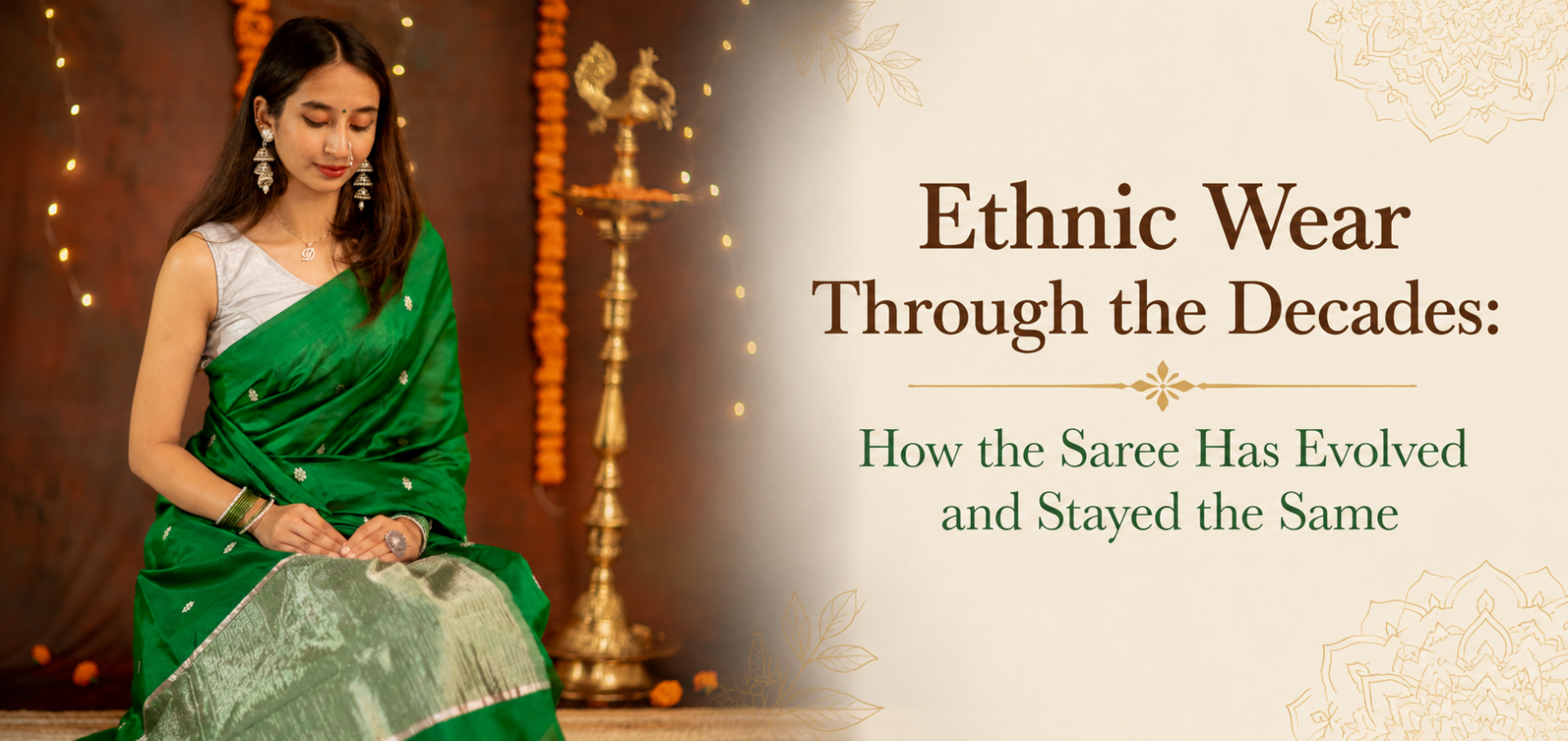
Ethnic Wear Through the Decades: How the Saree Has Evolved and Stayed the Same
Few garments carry as much continuity as the saree. Across roughly five thousand years of documented use, the six-yard drape has moved through empires, independence movements, film industries, and now e-commerce platforms, without losing its basic form. The History of Indian Sarees is really a history of Indian craftsmanship itself — one that keeps adapting its surface (fabric, print, blouse style) while keeping its structure untouched. This piece traces that arc decade by decade and looks at why, despite constant reinvention, the saree has never needed replacing.
What Is the History of Indian Sarees, in Brief?
The History of Indian Sarees spans from Indus Valley textile fragments dated to around 2800–1800 BCE to today's handloom and power-loom industries. The garment has remained an unstitched drape throughout, while its weaving techniques, motifs, and regional identities — Chanderi, Maheshwari, Banarasi, Kanjeevaram — evolved independently across India's textile belts.
The Earliest Roots: Sarees Before Independence
Sculptures from the Gupta period (4th–6th century CE) and earlier Sangam-era Tamil literature both describe women draped in unstitched cloth, suggesting the saree predates most stitched garments worn in the subcontinent today. Regional weaving clusters formed around local resources: cotton in the Deccan plains, silk in Bengal and Karnataka, and zari (metallic thread) work wherever royal patronage supported it.
Handloom Traditions Across Regions
By the Mughal era, court patronage had turned weaving into a specialised craft passed down through families. Banaras became known for brocade, Paithan in Maharashtra for its distinctive pallu, and the Malwa region — home to Maheshwar — for a lighter, reversible weave that would later be named after the town itself.
Post-Independence Revival and the Handloom Movement
After 1947, the newly formed Indian government treated handloom weaving as both cultural heritage and rural employment policy. The All India Handicrafts Board, established in 1952, and later the Handloom Reservation Act of 1985, protected weaving clusters from being displaced entirely by mechanised textile mills.
The 1980s–2000s: Sarees Meet Cinema and Mass Production
Hindi and regional cinema had an outsized effect on saree trends from the 1980s onward. Chiffon and georgette sarees, popularised through films of that period, briefly overtook handwoven cotton and silk as the aspirational choice for urban buyers. Simultaneously, power looms began producing lower-cost synthetic sarees at a volume handlooms could never match, which put real economic pressure on traditional weaving families.
By the early 2000s, industry estimates suggested handloom's share of India's overall saree production had fallen to a fraction of what it was at independence, even though total saree consumption kept rising.
The 2010s Onward: A Sustainable, Artisan-First Revival
The last decade has reversed some of that decline. Rising interest in slow fashion, natural dyes, and traceable supply chains has brought handloom sarees back into mainstream retail, not just heritage boutiques. Techniques like wax-resist dyeing, seen in indian batik sarees, have found new audiences among buyers who want a visible, tactile difference from printed fabric — batik's slightly irregular crackle pattern is a direct result of hand-applied wax cracking during dyeing, not a design flaw.
Similarly, demand for a pure maheshwari silk saree has grown among buyers specifically looking for the distinctive reversible border and cotton-silk warp-weft construction that machine-made imitations struggle to replicate.
How Saree Weaving Eras Compare
Looking at four broad periods side by side makes the shift in production method, not just style, easier to see.
- Pre-1900s: Entirely hand-spun and handwoven; natural dyes from indigo, madder, and turmeric; motifs tied to regional temple architecture or royal court patterns.
- 1950s–1970s: Government-backed handloom cooperatives standardise regional weaves; mill-made cotton sarees enter mass retail for the first time.
- 1980s–2000s: Power looms and synthetic fibres dominate volume; Bollywood-driven fabric and colour trends shift buying patterns nationally.
- 2010s–present: Renewed demand for handloom, natural dyes, and documented artisan sourcing; e-commerce makes regional weaves like Chanderi and Maheshwari accessible outside their home states.
What Has Stayed the Same? The Unchanging Soul of the Saree
Despite every shift in fibre, print, and marketing, three things haven't changed since the earliest recorded sarees: the unstitched six-to-nine-yard length, the drape-based construction requiring no cutting or fixed sizing, and the pallu as a canvas for regional identity. A weaver in Maheshwar today still sets up a pit loom using the same warping principle used generations ago, even if the yarn now arrives dyed rather than hand-dyed on site.
Buying Sarees Today: What to Look For
Buyers shopping maheshwari silk sarees online should check for the reversible border and the slightly stiff, papery texture that comes from the cotton-silk blend — a fully silk saree marketed under the same name is usually mislabelled. For prints, genuine batik print sarees online will show minor variation between panels, since each length is waxed and dyed by hand rather than run through a single print roller.
As a general rule, a saree with perfectly uniform, repeating print patterns and a very light, almost paper-thin drape is more likely mill-made than handwoven, regardless of what the listing claims.
Frequently Asked Questions
What is the actual origin of the saree?
The saree's origins trace back to the Indus Valley Civilisation, roughly 2800–1800 BCE, based on textile fragments and sculpture evidence. It developed as an unstitched drape long before stitched garments became common in the subcontinent, making it one of the oldest continuously worn garment forms in the world.
Why did handloom sarees decline in the late 20th century?
Power looms and synthetic fibres allowed factories to produce sarees far faster and cheaper than hand weavers could. Combined with shifting fashion trends from cinema, this pushed many traditional weaving families out of the market between the 1980s and early 2000s, even as overall demand for sarees grew.
What makes a Maheshwari saree different from other silk sarees?
A genuine Maheshwari saree uses a cotton-silk blend in its warp and weft, giving it a lighter weight and reversible border unique to the Maheshwar region of Madhya Pradesh. This construction method dates back to the 18th century and distinguishes it from pure silk weaves like Kanjeevaram or Banarasi.
Is batik printing done by hand or machine?
Traditional batik is a hand process involving wax-resist dyeing, where wax is applied to fabric before dyeing to block colour in specific areas. The wax is then removed, revealing the pattern. This is why genuine batik sarees show slight irregularities between pieces, unlike machine-printed imitations.
How can I tell if a saree is handwoven or machine-made?
Handwoven sarees typically show minor inconsistencies in weave tension, slightly uneven print alignment on hand-dyed pieces, and a denser, more textured hand-feel. Machine-made sarees tend to have perfectly uniform patterns and a lighter, more uniform drape. Checking the reverse side of the fabric for thread irregularities is a reliable way to confirm handwork.
In summary: the History of Indian Sarees is a record of continuous adaptation rather than replacement — from Indus Valley drapes to Mughal-era brocades, post-independence handloom protection, Bollywood-driven mass production, and today's renewed interest in artisan-made weaves. Through every shift in fibre and fashion, the unstitched drape and regional weaving identity have remained constant, which is why techniques like Maheshwari weaving and batik dyeing still hold relevance in Indian wardrobes today.
-
Which Saree Should I Wear? Easy Choices for Weddings, Office, Festivals & Everyday
September 17th, 2026 -
 August 25th, 2026
 -
What to Wear for Ganesh Chaturthi: Saree Colours and Styling Guide
August 24th, 2026 -
 August 24th, 2026