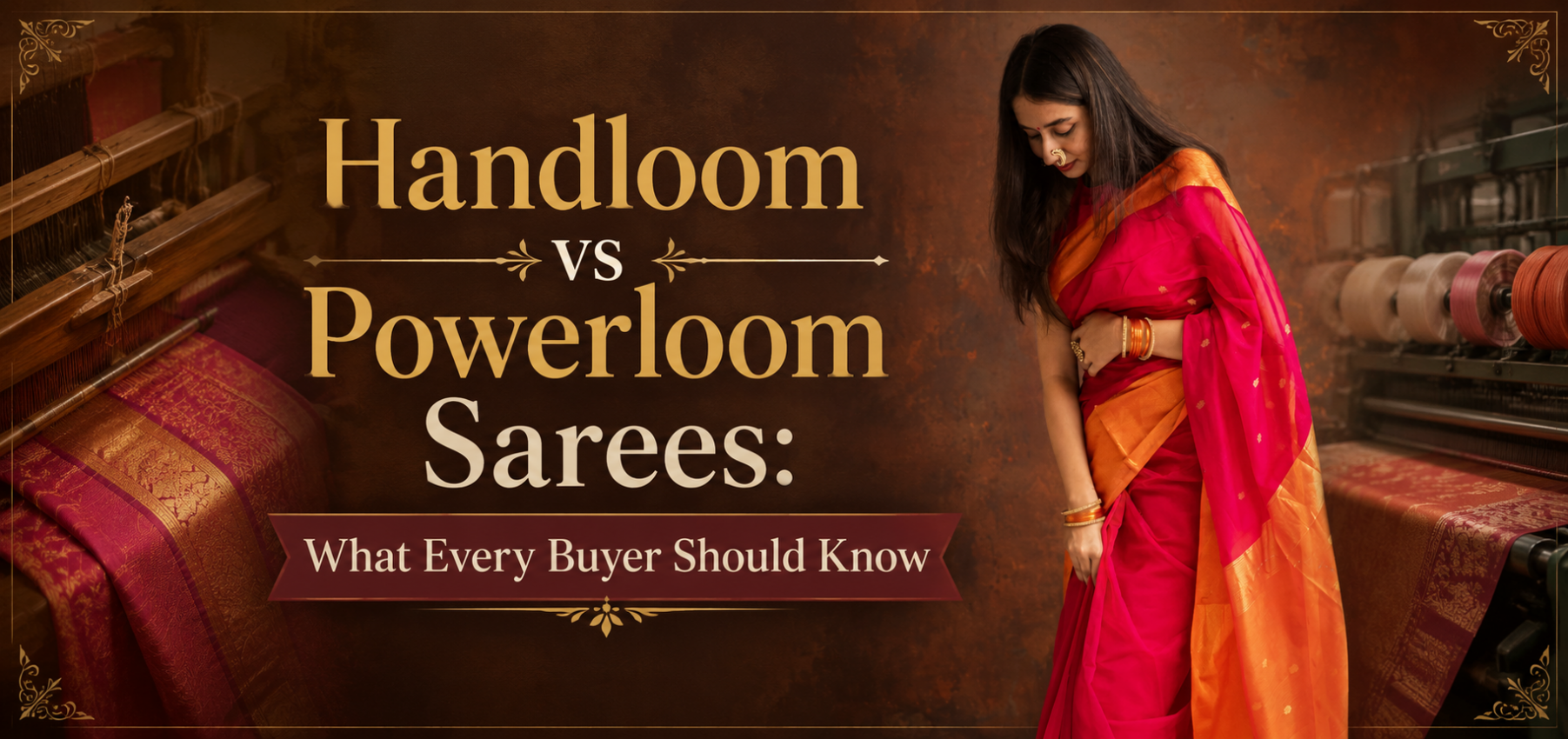
Handloom vs Powerloom Sarees: What Every Buyer Should Know
Walk into any saree shop — physical or online — and you will find two types of products sitting side by side, often looking almost identical. One is woven by human hands, thread by thread, carrying hours of artisanal labour. The other rolls off a machine in minutes. Both are called sarees, but they are worlds apart. This guide breaks down the real difference between handloom vs powerloom sarees so you can make a purchase you will never regret.
India is a nation of weavers. For thousands of years, our artisans have created textiles that the world admired. The handloom industry today supports over 4.3 million weavers across the country, yet the market is flooded with machine-made imitations that often pass off as authentic handwoven fabric. If you are someone who loves sarees and cares about what you wear, understanding this difference is not just useful — it is essential.
What Is a Handloom Saree?
A handloom saree is woven on a traditional loom operated entirely by human hands and feet — no electricity, no automation. Every single thread that makes up the fabric is interlaced manually by a skilled artisan, often working 8 to 12 hours a day. Depending on the complexity of the design, weaving one saree can take anywhere from two days to several weeks.
The weaving communities in India — whether it is the weavers of Maheshwar in Madhya Pradesh, the Chanderi craftspersons, the Banarasi weavers of Varanasi, or the Kanjeevaram silk artisans in Tamil Nadu — have inherited this craft through generations. Each weave carries a regional identity, a set of motifs, a specific thread quality, and a way of draping that makes it unlike anything produced anywhere else in the world.
Production Time 2 days to 4+ weeks per saree depending on design complexity
Weaver's Touch Each thread placed manually — no two sarees are perfectly identical
Cultural Value Carries regional identity, craft lineage, and generational knowledge
Material Quality Often uses pure silk, cotton, or zari in authentic, natural forms
What Is a Powerloom Saree?
A powerloom saree is produced on an electrically operated loom that automates the weaving process. These machines can produce multiple sarees in the time it takes a handloom weaver to finish a single piece. Factories operate at large scale, keeping costs low and production volumes high.
Powerloom sarees are not inherently inferior in terms of fabric material — many are made from decent cotton, polyester, or synthetic blends. However, the difference lies in the uniformity, the lack of artisanal identity, and the absence of the human element that gives a handloom saree its soul.
Importantly, powerloom production contributes to the displacement of skilled weavers who spend years mastering their craft. When a machine replicates — however imperfectly — what an artisan creates, and is sold at a fraction of the price, it puts enormous pressure on the handloom community.
A Side-by-Side Look: Handloom vs Powerloom Sarees
Here is a structured comparison to help you understand the key differences between the two at a glance.
Feature | Handloom Saree | Powerloom Saree |
Production Method | Hand-woven on traditional loom | Machine-woven using electric looms |
Time to Produce | Days to weeks per piece | Minutes to hours per piece |
Texture & Drape | Soft, natural, slightly irregular | Uniform, crisp, machine-smooth |
Uniqueness | Every piece is one-of-a-kind | Mass-produced, identical copies |
Price Range | Higher due to labour & craftsmanship | Lower due to automation |
Durability | Long-lasting with proper care | Moderate; synthetic blends may weaken |
Artisan Support | Directly supports weaver livelihoods | No direct artisan involvement |
Environmental Impact | Lower; often natural fibres & dyes | Higher; often synthetic materials |
Best For | Weddings, festivals, gifting, heirlooms | Everyday casual wear, budget shopping |
How to Tell a Real Handloom Saree Apart
With so many powerloom products being marketed as handloom, knowing how to distinguish between the two is one of the most practical skills a saree buyer can have. Here are some reliable indicators to look for.
Check the Weave for Natural Irregularities
A handloom saree will almost always have tiny imperfections — a slightly uneven thread, a minor variation in the pattern repeat, or a subtle difference in density across the fabric. These are not flaws; they are the fingerprints of the human hand. A powerloom saree, by contrast, is mechanically perfect and uniform throughout.
Feel the Fabric's Weight and Softness
Genuine handloom fabrics tend to feel softer and more breathable against the skin. The texture has depth — it is not flat or plasticky. When you hold a handloom silk saree up to light, you will notice a natural lustre rather than a synthetic sheen.
Look at the Selvedge (Border Edge)
In a handloom saree, the selvedge — the finished lengthwise edge — is typically tighter and more neatly woven. Look for the Handloom Mark, a government certification logo that appears on certified handwoven products in India. This mark is a reliable indicator of authenticity.
Examine Zari and Border Work Closely
In handwoven sarees, the zari (metallic thread) used in borders and pallu is integrated into the weave. In powerloom versions, it is often printed or loosely attached. Real woven zari catches light differently — it has dimensional richness rather than a flat, printed metallic look.
- Ask the seller for a Handloom Mark certificate or GI tag where applicable
- Buy directly from weavers or trusted artisan brands to avoid fakes
- Be cautious of extremely low prices on "silk" or "zari" sarees — authentic materials have a real cost
- Slight colour variations across the body of the saree suggest natural dyeing and handcraft
- A heavier saree for its size often indicates quality yarn — not padding or stiffening agents
The Craft Behind Popular Indian Handloom Traditions
India's handloom traditions are as diverse as its geography. Each region produces a distinctive weave that reflects its climate, culture, and available materials. Understanding these traditions helps you appreciate why a handloom saree is worth its price.
Maheshwari Weaving from Madhya Pradesh
Originating from the royal town of Maheshwar on the banks of the Narmada river, Maheshwari sarees are known for their reversible borders, fine texture, and lightweight drape. They are traditionally woven with a mix of silk and cotton, making them comfortable for both daily and formal wear. If you are looking for maheshwari silk sarees online, it is important to source from sellers who work directly with weavers from the Maheshwar region to ensure authenticity.
Chanderi — Where Silk Meets Sheerness
Chanderi sarees from the Chanderi town in Madhya Pradesh are prized for their gossamer-light texture and natural sheen. Traditionally woven in silk and cotton, with handwoven gold and silver zari motifs, they are among the most refined handloom products India produces. The chanderi tissue saree variety is especially elegant — the tissue weave catches light beautifully and gives the saree a luminous, festive character.
Block Printing and Hand Painting
Not all handcrafted sarees are purely woven — many are distinguished by their surface treatments. Block printing, which uses carved wooden blocks dipped in natural dyes to stamp motifs onto fabric, is an art form in itself. Similarly, hand-painted sarees where artists use brushes and fabric colours to paint detailed scenes and patterns are valued for their uniqueness. A genuine batik print cotton saree or hand-painted silk is a wearable artwork — no two pieces will ever be alike.
Why the Price Difference Is Justified
One of the most common objections buyers have is the price. Why pay ₹3,000–₹15,000 or more for a handloom saree when a powerloom version of similar appearance is available for ₹500–₹800? The answer lies in understanding what you are actually paying for.
Consider a Maheshwari silk saree. The weaver typically earns ₹200–₹500 a day. A moderately complex saree takes 3–5 days to weave. Factor in the cost of pure silk yarn, silver zari, natural dyes, the intermediary (if any), and packaging — and a price of ₹3,500 to ₹6,000 represents fair, not excessive, compensation for skilled labour and quality materials.
"When you buy a handloom saree, you are not just buying fabric. You are buying someone's time, skill, livelihood, and a piece of India's cultural heritage."
A powerloom saree may look similar in photographs but will not drape the same way, will not age as gracefully, and will not carry the emotional weight that comes with owning something made by human hands. Over years of wearing, the difference becomes unmistakable.
When to Choose Handloom and When Powerloom Works
Being a thoughtful buyer does not mean you have to choose handloom every single time. Here is a practical guide to help you decide based on occasion and intent.
Choose Handloom When:
- You are buying for a wedding, festival, or formal celebration
- You want a saree that will last decades and can be passed down
- You are gifting — a handcrafted saree is a meaningful, premium gift
- You care about sustainability and artisan welfare
- You want something truly unique that no one else will have
Powerloom May Be Practical When:
- You need everyday office or casual wear on a tight budget
- You are buying for a school function or a one-time event
- You want a specific trend-driven look without long-term investment
The key is to be conscious. Know what you are buying and from whom. Many sellers label powerloom products as "handloom" to charge premium prices — this is both misleading and harmful to real artisan communities.
Handloom and Sustainability Go Hand in Hand
Handloom production uses significantly less energy than powerloom manufacturing. Traditional weavers often work with natural fibres like cotton, silk, and wool, and many use plant-based or mineral dyes that are far gentler on the environment than synthetic chemical dyes used in industrial production. Choosing handloom is one of the most effective ways to embrace slow fashion — buying less, buying better, and making it last longer.
Shopping for Authentic Handwoven Sarees Online — What to Look For
The rise of e-commerce has made it easier to access handcrafted sarees online from weaving communities across India, without needing to travel to textile towns. However, it has also opened the door to misrepresentation. Here is how to shop smart.
- Read the product description carefully — legitimate sellers will name the weave type, region of origin, material, and often the artisan or cluster it comes from
- Look for close-up fabric images — authentic handloom sellers photograph the texture, the weave pattern, and the border in detail; powerloom sellers often use flat, studio-lit shots that hide the lack of depth
- Check for Handloom Mark or GI certification mentions on the product page
- Read buyer reviews and look for mentions of fabric quality, drape, and whether the product matched the description
- Prefer brands with artisan stories — sellers who name their weavers, share origin stories, and describe their craft process are typically the real thing
When you shop for handmade sarees online, paying attention to these details ensures that your purchase reaches a genuine artisan, not a machine factory.
The Handloom Industry in India — Why It Needs Your Support
India's handloom sector employs the second-largest number of people in the country after agriculture. Yet, in recent decades, the sector has faced serious pressure from cheap powerloom imitations, declining consumer awareness, and the migration of younger generations away from weaving as a livelihood.
When a master weaver has no buyers, the craft dies with them. Many traditional weaves — some centuries old — are already at risk of extinction simply because demand has shifted to machine-made alternatives. Every handloom saree purchase is a vote for keeping these arts alive.
The handwoven tissue saree tradition, for example, requires extraordinary skill in creating the sheer, gossamer texture unique to tissue weaves — a skill that takes years to master. Supporting artisans who create such pieces ensures that future generations will still have access to this level of craft.
Informed Choices Make a Real Difference
The next time you are shopping for a saree — whether for yourself or as a gift — take a moment to look beyond the surface. Ask where it was made, who made it, and how. The answers will tell you a great deal about what you are really getting.
Handloom and powerloom sarees can both serve a purpose in a wardrobe. But knowing the difference ensures you never pay a handloom price for a powerloom product, never miss out on the genuine beauty of a hand-woven piece, and never unknowingly contribute to the displacement of skilled artisan communities.
India's textile heritage is living, breathing, and exquisitely beautiful. It deserves to survive — and it does so, one conscious purchase at a time.
Frequently Asked Questions
How Can I Tell if a Saree Is Handloom or Powerloom?
Check for slight irregularities in weave patterns — they indicate handwork. Handloom sarees often have a selvedge (a neat edge along the length), minor variations in texture, and a softer drape. Powerloom sarees are uniformly perfect, machine-smooth, and lighter in weight. Also look for the Handloom Mark — an official Indian government certification that appears on authenticated handwoven products.
Why Are Handloom Sarees More Expensive Than Powerloom Ones?
Handloom sarees are woven thread by thread by skilled artisans, a process that can take days or even weeks for a single piece. The time, expertise, and labour involved — along with the use of quality natural yarns, pure silk, or genuine zari — justifies the higher price. When you buy handloom, a significant share of the price goes directly to the weaver, making it both a quality and an ethical purchase.
Are Powerloom Sarees of Poor Quality?
Not necessarily poor quality, but they are mass-produced and lack individual character. Powerloom sarees can be made from reasonable fabrics including cotton blends, but they do not carry the artisanal identity, cultural value, or long-term durability of a genuine handloom piece. For everyday budget wear, powerloom is practical; for occasions, gifting, or long-lasting wardrobe investments, handloom is the better choice.
Which Saree Type Is Best for a Wedding or Festival?
Handloom sarees are ideal for weddings and festivals due to their richness, unique craftsmanship, and heirloom quality. Traditional weaves like Maheshwari silk, Chanderi tissue, Banarasi, and Kanjeevaram are especially popular for special occasions. They drape beautifully, carry cultural significance, and remain in excellent condition for decades when cared for properly.
Does Buying a Handloom Saree Actually Support Artisans?
Yes, significantly. When you purchase an authentic handloom saree from a responsible seller, a meaningful portion of the price goes directly to the weaver or weaving cluster. It supports their daily livelihood, preserves traditional Indian textile knowledge passed down through generations, and encourages sustainable, ethical fashion. India has over 4 million handloom weavers — your buying choices have a direct impact on their economic well-being.
-
Which Saree Should I Wear? Easy Choices for Weddings, Office, Festivals & Everyday
September 17th, 2026 -
 August 25th, 2026
 -
What to Wear for Ganesh Chaturthi: Saree Colours and Styling Guide
August 24th, 2026 -
 August 24th, 2026