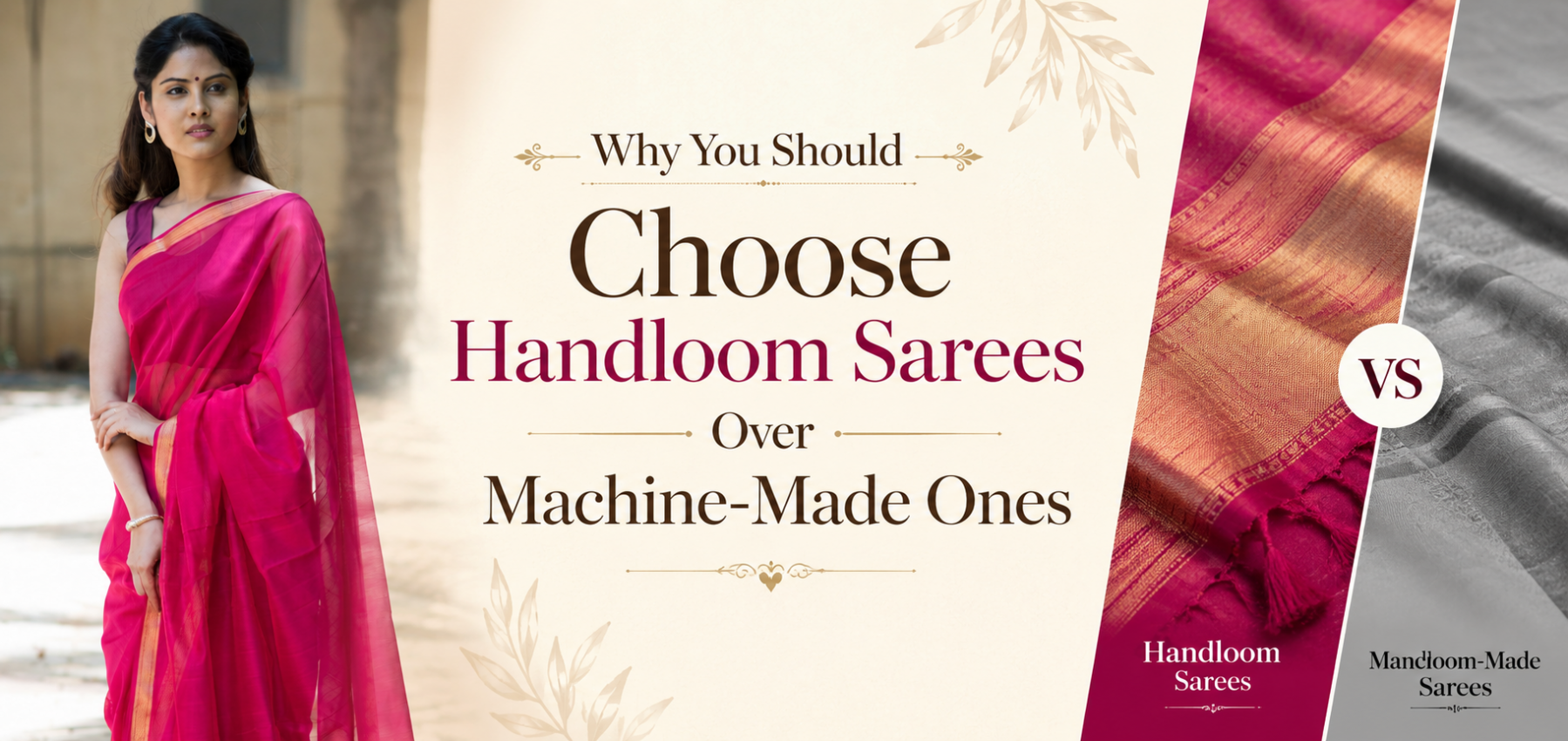
Why You Should Choose Handloom Sarees Over Machine-Made Ones
Every time you drape a saree, you are making a statement — not just about your style, but about what you value. In a world flooded with fast fashion, the choice between a handloom saree and a machine-made one carries more weight than most people realise. This guide will help you understand what makes handloom sarees truly irreplaceable, from the hands that weave them to the legacy they carry.
What Exactly Is a Handloom Saree?
A handloom saree is woven entirely by skilled artisans on a manual loom — with no automated machinery involved in the weaving process. Every single thread is interlaced by hand, often using techniques passed down through generations. This is a craft that cannot be rushed. Depending on the complexity of the design, a single saree can take anywhere from two days to several weeks to complete.
India is one of the world's largest producers of handloom textiles. Regions like Madhya Pradesh (known for Maheshwari and Chanderi weaves), Varanasi, Kanjipuram, Odisha, and West Bengal each have their own signature styles — each a living chapter of India's textile history.
The handloom sector in India employs over 35 lakh weavers, making it the second-largest employment sector after agriculture.
35L+ Weavers employed across India
2–4 Weeks to weave a premium handloom saree
500+ Distinct handloom weaving traditions in India
₹31,000 Cr India's handloom export value annually
A machine-made saree, by contrast, is produced in large factories using power looms or fully automated jacquard machines that can replicate patterns at lightning speed and minimal cost. While they are widely available and budget-friendly, they carry none of the soul or story that a handcrafted piece holds.
The Craftsmanship Gap: Human Hands vs. Industrial Machines
The most fundamental difference between handloom and machine-made sarees lies in how they are made. When an artisan sits at a loom, every movement is intentional. The fingers adjust thread tension, the eyes check pattern alignment, and the creative instinct of years of practice is woven into every centimetre of fabric. This level of attention simply cannot be replicated by a machine.
The Weaver's Knowledge Is the Fabric
Master weavers spend decades perfecting the art of reading pattern cards (locally called "naksha"), adjusting thread counts, and ensuring that the zari (metallic thread) falls at precisely the right angle to catch light. This intuitive expertise is what gives the best handloom sarees their distinctive drape, texture, and luminosity — qualities that even the most sophisticated power loom cannot simulate.
Take the maheshwari silk sarees online collection as an example. Originating from the banks of the Narmada river in Maheshwar, Madhya Pradesh, these sarees are woven with a combination of silk and cotton thread's using a specific ribbed weave pattern. The distinctive reversible border — which looks equally beautiful from both sides — is achieved only through a highly skilled manual process that machines cannot accurately reproduce.
Slight Imperfections Are the Mark of Authenticity
One of the most misunderstood aspects of handloom weaving is the role of natural variation. You might notice tiny irregularities in a handloom saree — a subtle shift in thread density, a slight variation in motif placement. These are not flaws. They are fingerprints of authenticity, proof that a human being made this for you.
Machine-made sarees are perfectly uniform, which is precisely what makes them feel impersonal and disposable.
“A machine can copy a design. It cannot copy the devotion of a weaver who has spent thirty years perfecting their craft.”
Handloom vs. Machine-Made: A Side-by-Side Look
For those who want clarity before making a decision, here is a structured comparison of the two:
Parameter | Handloom Sarees | Machine-Made Sarees |
Making Process | ✔ Hand-woven by skilled artisans | ✘ Automated power loom production |
Fabric Quality | ✔ Natural fibres, breathable, long-lasting | ✘ Often synthetic or mixed; less durable |
Uniqueness | ✔ Each piece is one-of-a-kind | ✘ Mass-produced, identical patterns |
Environmental Impact | ✔ Low carbon footprint, no electricity | ✘ High energy use, chemical dyes common |
Cultural Value | ✔ Carries heritage, story, and identity | ✘ No cultural narrative |
Artisan Livelihood | ✔ Directly supports weaving communities | ✘ Factory-based; artisan skills displaced |
Skin Feel | ✔ Soft, gentle, improves with age | ✘ Can feel stiff or rough on skin |
Price | Higher upfront cost | Cheaper, but lower longevity |
When you look at it this way, the value proposition of a handloom saree becomes very clear. The higher price is not a mark-up — it is a fair reflection of the time, skill, and cultural integrity embedded in every metre of fabric.
Why Handloom Sarees Are Gentler on the Planet
In an era of climate awareness and conscious consumption, the environmental story of handloom textiles is deeply compelling. Traditional handloom weaving uses no electricity during the weaving process itself. Artisans work with natural fibres like silk, cotton, linen, and wool — materials that are biodegradable and far gentler on ecosystems compared to synthetic alternatives.
Natural Dyes and Sustainable Practices
Many traditional handloom clusters continue to use plant-based or mineral dyes — derived from indigo, turmeric, pomegranate rind, and iron oxide — which have negligible ecological impact. These dyes are not only safer for the weavers themselves but also produce colours with a depth and warmth that synthetic chemical dyes rarely achieve.
Those who are exploring handcrafted sarees online will notice that genuine handloom sellers often provide information about the dyes and fibres used — a transparency that mass-market brands rarely offer.
The Slow Fashion Movement and Handlooms
Slow fashion is not a trend — it is a philosophy. It argues that clothing should be made responsibly, purchased thoughtfully, and worn for years rather than seasons. Handloom sarees are the embodiment of slow fashion.
They are not designed to be worn once and discarded. A well-cared-for Maheshwari silk saree or Chanderi weave can last decades, becoming a treasured heirloom passed from mother to daughter.
Compare this to machine-made sarees manufactured from polyester or blended synthetics — they typically begin to fray, lose sheen, or pill within a year or two of regular use, inevitably ending up in landfills.
The Cultural Identity Woven Into Every Thread
India's handloom traditions are not just textile techniques — they are living cultural institutions. Each weaving cluster has its own vocabulary of motifs, colour combinations, and structural patterns that reflect the geography, mythology, and social identity of its region.
What Makes Regional Handlooms Unique
The Maheshwari saree, for instance, uses a distinctive combination of silk warp and cotton weft, with a characteristic five-stripe border (locally known as "bugdi") and a reversible pallu. These design decisions were not arbitrary — they evolved over centuries through the patronage of the Holkar dynasty of Indore and the skill of Maheshwar's weaving community.
Similarly, the handwoven tissue saree — woven with a combination of fine silk and metallic zari threads — produces a luminous, almost translucent fabric that drapes with extraordinary grace. The interplay of light on tissue sarees is entirely a product of how the zari is interlaced by hand; a machine cannot calibrate this to the same visual effect.
When you wear a handloom saree, you are not just wearing fabric. You are wearing the story of a weaving community, a geographical legacy, and a craft lineage that has survived centuries of change.
The GI Tag: A Mark of Geographical Integrity
Many Indian handloom varieties carry Geographical Indication (GI) tags — a legal protection similar to France's AOC for wines — that certify their geographical origin and production method.
Banarasi brocade, Kanjivaram silk, Chanderi sarees, and Maheshwari fabrics all hold GI status. This is the government's recognition that these textiles are irreplaceable cultural products, not mere commodities.
How Choosing Handloom Directly Supports Artisan Communities
Behind every handloom saree is a family. In most traditional weaving clusters across Madhya Pradesh, Uttar Pradesh, Tamil Nadu, and Odisha, weaving is a household profession — practiced by multiple generations living under one roof.
When you choose a handloom saree over a machine-made one, your purchase directly funds the education, healthcare, and livelihood of these families.
The decline of handloom due to cheap machine-made competition has already pushed thousands of weaving families into poverty or forced them to abandon their craft entirely.
According to the National Handloom Development Corporation, the number of handloom weavers in India has declined significantly over the past two decades — largely because machine-made imitations sell at a fraction of the price, misleading buyers into thinking they are getting the same product.
Buying Ethically Is Buying Intelligently
When you invest in handmade sarees online from authentic brands that source directly from artisans, you are participating in a supply chain that is fair, transparent, and human.
The artisan earns a dignified wage. The craft survives. And you receive a garment of genuine quality that mass production simply cannot match.
“Choosing a handloom saree is an act of preservation — of a skill, a culture, and a community.”
Quality That Improves With Time: The Longevity Advantage
There is a reason why grandmothers' Banarasi sarees are still worn at weddings decades after they were purchased. Handloom sarees made from pure natural fibres — silk, cotton, linen — possess an inherent durability that synthetic machine-made sarees cannot match.
In fact, many silk handlooms develop a richer sheen over time, as the natural oils from repeated use condition the fibre.
Cost Per Wear: The Real Value Equation
A machine-made polyester saree may cost ₹500–₹1,500 and last two to three years. A quality handloom silk saree might cost ₹5,000–₹20,000 but last thirty years or more with proper care.
When you calculate cost per wear, handloom sarees are often the more economical choice in the long run — not to mention the environmental cost of repeatedly discarding and replacing synthetic clothing.
How to Identify a Genuine Handloom Saree
Given the prevalence of machine-made sarees being marketed as "handloom," here are reliable ways to verify authenticity before purchasing:
Look for the Handloom Mark
The Bureau of Indian Standards and the Ministry of Textiles issue an official Handloom Mark — a logo featuring a hand and loom — that certifies a product as genuinely hand-woven. Authentic sellers display this clearly.
Examine the Selvedge
The edges (selvedges) of a genuine handloom saree will show slight unevenness in threading. Machine-made selvedges are perfectly straight and machine-finished.
Hold It to Light
A handloom fabric, particularly silk, shows a natural irregularity in weave density when held up to a light source. Machine-made fabric appears perfectly uniform throughout.
Check the Pallu Carefully
The pallu (end piece) of a handloom saree will often show the weaver's signature pattern, which is slightly distinct from the rest of the fabric — a natural result of re-threading the loom for the decorative section.
Occasions Where Handloom Sarees Make an Unforgettable Statement
One of the most common misconceptions is that handloom sarees are only for older women or very formal occasions. The reality is quite the opposite. The range of handloom styles available today — from lightweight Chanderi cottons perfect for office wear to opulent tissue silks ideal for weddings — makes them incredibly versatile.
Weddings and Celebrations
Rich silk handlooms with gold zari borders and intricate woven motifs remain the first choice for brides and their families across India. The weight, drape, and grandeur of a genuine handloom silk saree is unmatched for celebratory occasions. Many families specifically seek out maheshwari silk sarees online for weddings, valuing their regal drape and reversible border.
Festivals and Pujas
For Diwali, Navratri, Durga Puja, Eid, or Onam — handloom sarees in festive colours draped with traditional elegance are a deeply meaningful choice. The cultural resonance of wearing a locally woven saree on a traditional occasion adds a layer of authenticity to the celebration itself.
Professional and Corporate Settings
Lightweight handloom cotton and linen sarees, in solid tones or subtle woven checks, are increasingly popular in professional settings. They project quiet confidence and cultural pride — a combination that many women in leadership positions actively seek in their professional wardrobe.
What to Look for When Shopping for Handloom Sarees Online
With the rise of e-commerce, purchasing authentic handloom textiles has become far more accessible — but also more confusing, given the number of sellers who misrepresent machine-made products as handloom.
Here is what genuine, trustworthy sellers should offer:
Weaving Origin Clearly Stated: Where was the saree made? Which weaving cluster or artisan group produced it? Authentic sellers tell you this, because provenance matters.
Fibre Composition Disclosed: Is it pure silk, silk-cotton blend, or cotton? Genuine handloom sellers are transparent about every material used.
Artisan or Workshop Information: The best sellers share the story of the weaver behind the product — their name, region, and craft tradition.
Certifications Visible: Handloom Mark, GI certification, or similar authenticity markers should be displayed or mentioned in product descriptions.
Return and Quality Policy: A confident, authentic seller will stand behind their products with a clear return policy and quality guarantee.
The Final Word: A Choice That Goes Beyond Fashion
Choosing a handloom saree over a machine-made one is not simply a shopping decision. It is a commitment — to quality, to culture, to the planet, and to the millions of skilled artisans whose entire way of life depends on whether people like you choose to value what they create.
India's handloom heritage is one of the most extraordinary cultural assets in the world. It is irreplaceable, and it is at risk.
Every handloom saree you buy is a small act of preservation — one that keeps ancient techniques alive, supports weaving families, and gives you something genuinely beautiful to wear and treasure.
If you are ready to explore some of the finest handwoven sarees India's artisan communities have to offer, take a look at the collection at Thread's Tale — where every piece carries a story worth wearing.
Frequently Asked Questions
How can I tell the difference between a handloom saree and a machine-made one?
Handloom sarees often have slight irregularities in texture, thread counts, or weave patterns — these are signs of genuine handcrafting. Machine-made sarees are perfectly uniform. Handloom sarees also tend to feel softer and more breathable. Look for the official Handloom Mark (issued by India's Ministry of Textiles) when buying, and check the selvedge edges — genuine handloom selvedges show natural, slight unevenness.
Are handloom sarees more expensive than machine-made ones?
Yes, handloom sarees typically cost more because they require days or even weeks of skilled artisan labour. However, they offer far superior quality, longevity, and cultural authenticity — making them a better long-term investment. When you calculate the cost per wear over many years, a handloom saree is often more economical than repeatedly replacing low-quality machine-made alternatives.
Which types of handloom sarees are most popular in India?
Some of the most cherished handloom varieties in India include Maheshwari silk sarees (Madhya Pradesh), Banarasi silk sarees (Uttar Pradesh), Chanderi sarees (Madhya Pradesh), Kanjivaram sarees (Tamil Nadu), Paithani sarees (Maharashtra), and Sambalpuri sarees (Odisha). Each region has its own weaving identity, signature motifs, and cultural history embedded in the fabric.
How do I care for a handloom saree to make it last longer?
Handloom sarees should ideally be dry-cleaned or gently hand-washed in cold water using a mild, pH-neutral detergent. Avoid soaking them for extended periods. Store them folded in soft muslin or cotton cloth — never in plastic covers, which can trap moisture. Keep them away from direct sunlight and humidity. For silk handlooms, regular airing (without washing) can keep them fresh between uses.
Is it safe to buy authentic handloom sarees online?
Yes, provided you buy from a trusted and transparent brand. Look for sellers who clearly state the weaving origin, fibre composition, and artisan information. Brands that display the Handloom Mark, GI certifications, or share the story of the weaver behind each product are more likely to be authentic. Reading customer reviews, checking return policies, and preferring brands with a clear quality guarantee also helps ensure a safe and satisfying purchase.
-
Which Saree Should I Wear? Easy Choices for Weddings, Office, Festivals & Everyday
September 17th, 2026 -
 August 25th, 2026
 -
What to Wear for Ganesh Chaturthi: Saree Colours and Styling Guide
August 24th, 2026 -
 August 24th, 2026