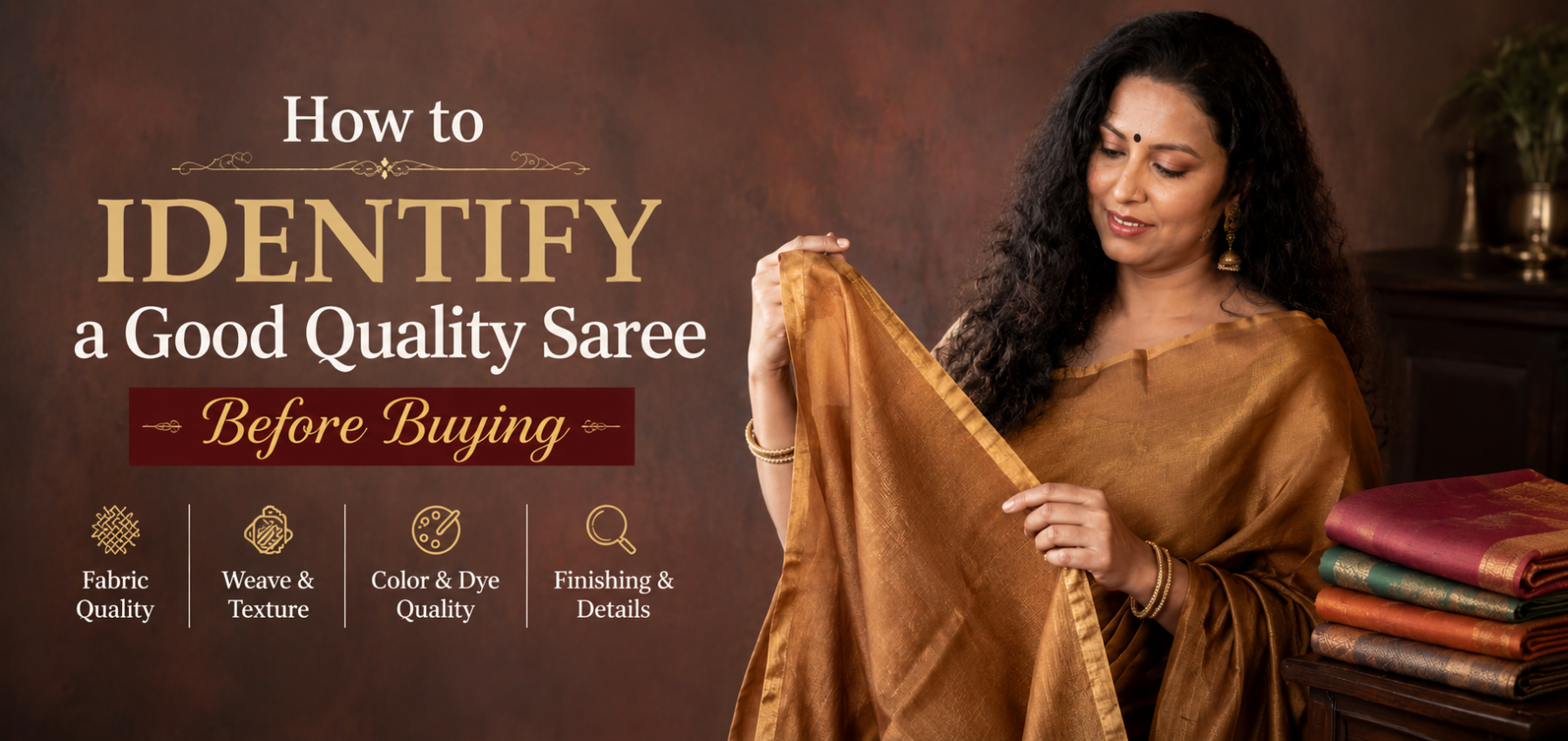
How to Identify a Good Quality Saree Before Buying
A saree can look stunning in a photograph and still fall apart at the pallu within three washes. Knowing how to judge fabric, weave, and finish before you pay is the only way to consistently find the best quality sarees in India, whether you are shopping in a store or scrolling through an online catalog. This guide breaks down exactly what separates a well-made saree from a mass-produced one, using the same checks weavers and textile buyers rely on.
What Makes a Saree "Good Quality"?
A good quality saree is defined by three things: natural or well-blended fibre, an even and tight weave with no loose threads, and finishing work (zari, prints, or embroidery) that is consistent on both the front and back. Handloom sarees typically show small, natural irregularities in the weave — a sign of human craftsmanship rather than a flaw.
Check the Fabric First: Signs of Genuine Handloom Weaves
Fabric is the first and fastest quality test. Rub a small section between your fingers and hold it up to light — genuine cotton, silk, or silk-cotton blends feel slightly textured and let light through unevenly, while synthetic blends feel uniformly smooth and glossy.
Cotton Sarees
Pure cotton sarees, such as those from Maheshwari or Chanderi weaving clusters, should feel breathable and slightly crisp, not slippery. A quick burn test on a loose thread (only on samples, never on the saree itself) is the traditional way weavers confirm cotton content — natural fibre chars into ash, while synthetic fibre melts into a hard bead.
Silk and Silk-Cotton Blends
Real silk has a subtle sheen that shifts with the angle of light, rather than a flat, uniform shine. Chanderi silk-cotton sarees, for instance, are woven with fine silk yarn in the warp and cotton in the weft, giving them a signature lightweight drape that pure polyester imitations cannot replicate.
Weave Density and Thread Count: The Technical Markers of Quality
Weave density tells you how much labour and yarn actually went into the saree. A tighter weave holds its shape longer, resists tearing, and drapes better on the body.
- Thread count check: Hold the fabric up to a light source. Fewer visible gaps between threads means a denser, higher-quality weave.
- Selvedge inspection: Handwoven sarees usually have a slightly uneven, hand-finished selvedge edge, unlike the razor-straight edge of power-loom fabric.
- Weight test: Genuine cotton or silk sarees have a natural heft. A saree that feels unusually light and slippery for its stated fabric is often heavily blended with synthetic fibre.
- Drape test: Drape a length over your arm. Quality fabric falls in soft, rounded folds; synthetic fabric tends to stand stiff or cling.
Zari, Prints and Embellishments: How to Spot Authentic Work
Authentic embellishment work is consistent, slightly raised, and identical on the reverse side of the fabric. Machine-printed imitations of hand techniques, by contrast, often show ink bleed, repeated patterns, or a flat print with no texture.
Genuine zari should feel slightly rough and cool to the touch, since it traditionally uses a silver or copper thread core. If the zari flakes, feels plasticky, or is uniformly shiny like foil, it is likely a synthetic substitute. For hand block prints, look closely for tiny inconsistencies in the pattern — no two motifs are ever perfectly identical when stamped by hand.
Wax-resist dyeing techniques are another marker worth learning to recognise. A well-made batik print cotton saree shows fine, natural crackle lines in the dye — a direct result of the wax-cracking process — rather than a printed imitation of the crackle effect. Genuine indian batik sarees also carry a faint wax smell before the first wash, since the dye is set using traditional hot-wax resist methods rather than digital printing.
For hand-painted fabrics, an authentic organza hand painted saree will show visible brush strokes and slight variations in paint saturation, since each motif is painted individually rather than screen-printed in bulk.
Border and Pallu Craftsmanship: A Quick Visual Test
The border and pallu carry the most weaving or embroidery work on a saree, which makes them the easiest place to judge overall craftsmanship. Turn the pallu over and check the reverse side.
On a well-made saree, the reverse of the border shows neatly finished thread ends, not loose hanging threads or visible glue. Zari borders should be woven into the fabric structure itself, not stitched or stuck on afterward — you can test this by gently tugging the border edge; woven zari will not peel away.
Where and How You Buy Matters
Fabric quality only tells half the story — sourcing matters just as much. Buying directly from weaver-linked sellers or verified artisan platforms reduces the chance of getting a power-loom copy sold as handloom. When you shop for handmade sarees online, look for sellers who disclose the weaving cluster, the artisan group, or the specific technique used, since vague product descriptions are often a sign of mass production.
Ask for close-up photographs of the weave, border reverse, and pallu before buying online. A seller confident in their craftsmanship will usually provide this without hesitation.
Best Quality Sarees in India: Regional Specialties Worth Knowing
India's textile map is regional, and each cluster is known for a specific technique that is difficult to replicate elsewhere. Knowing these names helps you shop with more precision.
- Maheshwari, Madhya Pradesh: Known for a distinctive reversible border and a fine cotton-silk blend developed in the 18th century.
- Chanderi, Madhya Pradesh: Famous for a sheer, lightweight texture achieved using fine silk and cotton yarn together.
- Bagru and Sanganer, Rajasthan: Centres for hand block printing using natural, vegetable-based dyes.
- Kalahandi and coastal Odisha: Known for wax-resist Batik dyeing traditions.
Sarees woven or dyed in these clusters, when sourced correctly, are consistently regarded as some of the finest handloom pieces available today, valued for their durability, natural fibre content, and traceable craftsmanship.
Modern Saree Looks Without Heavy Work: Simple & Elegant Styling Ideas
A well-made saree does not need dense embroidery or heavy embellishment to look elegant — a clean weave, a good drape, and the right styling do most of the work. This is especially useful for buyers who want versatility across occasions rather than a single-use festive piece.
For Weddings and Celebrations
Pair a lightly worked Chanderi or Maheshwari saree with a contrast blouse and statement jewellery instead of relying on heavy zari work for impact. Many modern sarees for wedding now use minimal embellishment with strong colour blocking or subtle woven borders, letting the fabric quality and silhouette carry the look.
For Office and Daily Wear
Cotton and cotton-silk sarees in solid tones or fine block prints work well for professional settings, since they drape neatly without excess volume. A structured pleat, a fitted blouse, and minimal jewellery are usually enough to make a best saree for office wear choice look polished through a full workday.
For Everyday Elegance
A single statement accessory — a cuff, a waist belt, or a contrast blouse — can update a simple handwoven saree without adding embellishment to the fabric itself. This keeps the saree lightweight, breathable, and easy to reuse across seasons.
Quick Checklist Before You Buy
- Rub the fabric between your fingers and check for texture, not uniform smoothness
- Hold it to light and check thread density
- Inspect the border reverse for clean, woven finishing
- Check zari for weight, texture, and colour consistency
- Ask the seller for the weaving cluster or technique name
- Request close-up photos before buying online
Frequently Asked Questions
How can I tell if a saree is handloom or power loom?
Handloom sarees usually show slight irregularities in the weave, a hand-finished selvedge edge, and natural weight in the fabric. Power loom sarees tend to have a perfectly uniform pattern, a razor-straight edge, and a lighter, more slippery feel due to higher synthetic content.
What is the best fabric for a saree in India's climate?
Cotton and cotton-silk blends like Chanderi and Maheshwari are best suited to India's warm climate, as they are breathable and lightweight. Pure silk sarees remain a strong choice for evening or festive wear, particularly in cooler months.
Does a higher price always mean better saree quality?
Not always. Price often reflects the intricacy of the design or the amount of zari used, but a simply woven, well-finished cotton saree can be higher quality than an expensive, heavily embellished but poorly finished one. Checking fabric and finish directly is more reliable than price alone.
How do I care for a handwoven saree to keep its quality?
Hand-wash or dry-clean handwoven sarees separately, especially those with natural dyes or zari borders, since machine washing can weaken the weave and fade colour. Store them folded in breathable cotton cloth rather than plastic to prevent the fabric from yellowing or the zari from tarnishing.
Can I style a simple saree for a wedding without heavy embroidery?
Yes. A well-woven saree with a clean border can be styled for weddings using a contrast blouse, layered jewellery, or a structured drape, without needing dense embroidery. This approach also makes the saree reusable for other occasions afterward.
In summary: identifying a good quality saree comes down to four checks — fabric feel, weave density, finishing consistency, and sourcing transparency. A saree that passes these checks, whether it is a hand block print, a Batik weave, or a fine Chanderi silk-cotton blend, will hold its shape, colour, and drape for years, making it a genuinely sound investment rather than a one-season purchase.
-
Which Saree Should I Wear? Easy Choices for Weddings, Office, Festivals & Everyday
September 17th, 2026 -
 August 25th, 2026
 -
What to Wear for Ganesh Chaturthi: Saree Colours and Styling Guide
August 24th, 2026 -
 August 24th, 2026