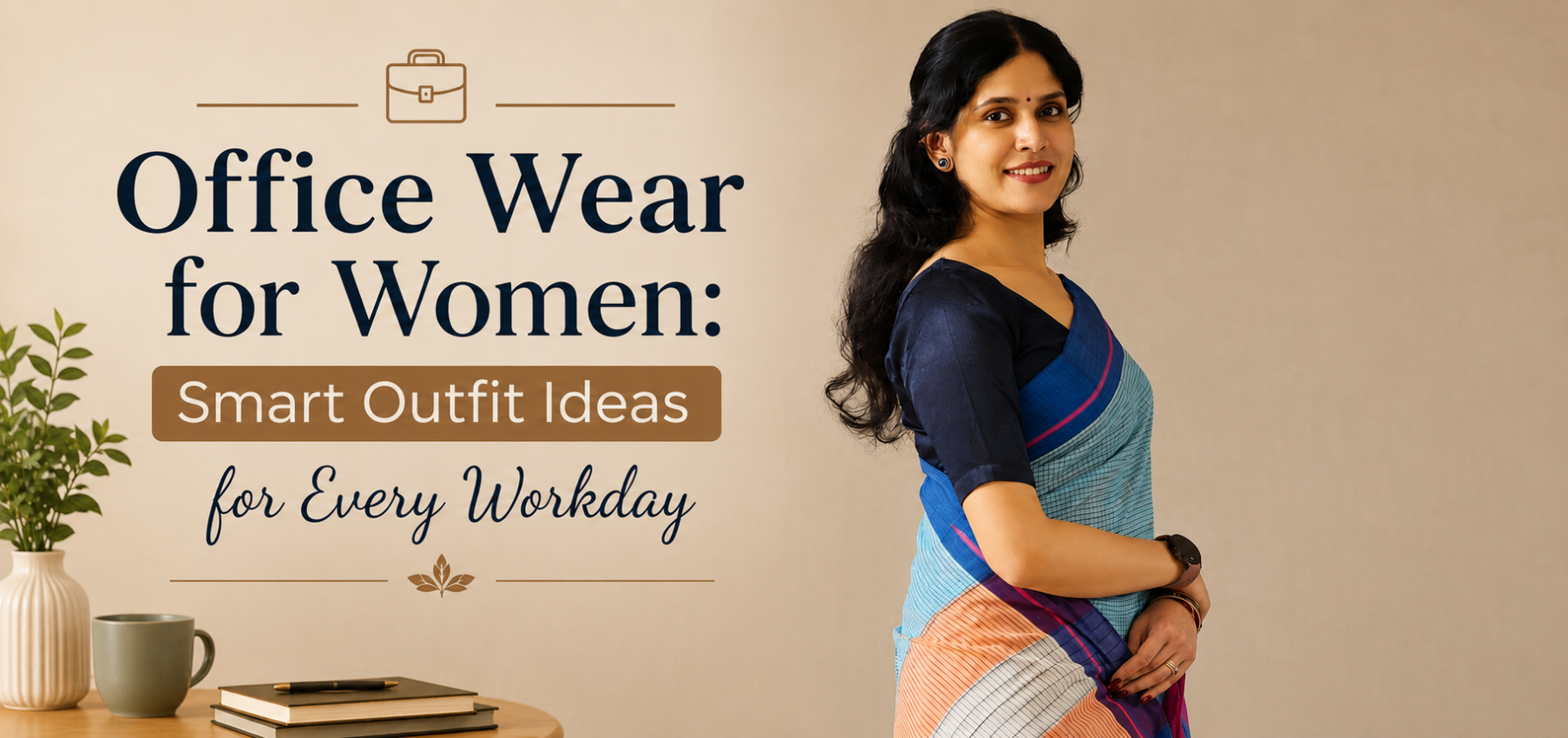
Office Wear for Women: Smart Outfit Ideas for Every Workday
Office wear for women doesn't need elaborate pleating or an hour at the mirror to look put together. A well-chosen saree in the right fabric, paired with a simple drape and minimal accessories, can be ready in under fifteen minutes and still hold its shape through a full workday. This guide breaks down which fabrics, drapes and pairings make sarees genuinely wearable for office settings across India, from Mumbai's humid mornings to Delhi's air-conditioned boardrooms.
What Makes a Saree "Low-Effort" for Office Wear?
A low-effort office saree is one made from lightweight, low-crease fabric with minimal embellishment, worn in a simple drape style such as the seedha pallu or a pre-pleated variant. Cotton, linen, mul cotton, Maheshwari silk and Chanderi are the most common choices because they hold pleats without constant adjustment and don't wrinkle heavily during an eight-hour workday.
Choosing the Right Fabric for Everyday Office Sarees
Fabric choice determines almost everything about how much effort a saree demands — from draping time to how it looks by 5 pm. Some fabrics need re-pinning every few hours; others hold their form from the morning commute to the evening meeting.
Cotton and Mul Cotton
Cotton sarees remain the most practical choice for daily office wear in India's climate. They breathe well, absorb sweat without clinging, and their natural texture hides minor creasing far better than silk. Mul cotton, a finer and softer variant, drapes closer to the body and works well under blazers or structured jackets for a more formal look.
Chanderi and Maheshwari Silk
Chanderi sarees carry a natural sheen and a crisp, papery texture that makes pleats sit neatly without pressing. A pure maheshwari silk saree offers similar structural advantages — the fabric's characteristic stiffness, achieved through a cotton-silk blend weave, means the pallu holds its fall through long meetings instead of slipping repeatedly.
Linen
Linen has become a workplace favourite over the last few years because it creases in a way that reads as texture rather than untidiness. A linen saree in a solid or subtly striped weave pairs easily with minimal jewellery for a look that feels deliberate, not undone.
Drape Styles That Take Under 10 Minutes
The seedha pallu (Gujarati-style) and the standard Nivi drape are the fastest options for office mornings, requiring only five to seven pleats at the front and a single pin at the shoulder. Pre-stitched or pre-pleated sarees reduce this further, since the pleats are permanently sewn in and only the pallu needs adjusting.
- Nivi drape: The most familiar style across India — pleats tucked at the front, pallu draped over the left shoulder. Takes roughly 8–10 minutes with practice.
- Seedha pallu drape: The pallu is pinned at the front instead of falling over the shoulder, which keeps it secure during desk work and commuting. Common in western India and increasingly popular for office wear.
- Pre-pleated saree: Pleats are stitched in advance; the wearer only wraps and pins. Ideal for early mornings or back-to-back meeting days.
- Saree with attached pallu: The pallu is stitched onto the pleats as a single unit, eliminating the need to redo the drape if it slips.
Colours and Prints That Work Best in a Professional Setting
Solid colours and small, evenly spaced prints photograph and read better in professional settings than large florals or heavy borders. Muted tones — soft grey, ink blue, olive, rust and off-white — pair easily with most blouse colours already in a working wardrobe, reducing the need to buy matching pieces for every saree.
Hand block prints and batik work offer a middle ground between plain and patterned. Someone building a rotation of easy-to-style options might look at batik print sarees online for pieces that carry visual interest through print alone, without embroidery or embellishment that would otherwise need careful handling.
Building a Capsule Wardrobe: Office Wear for Women That Rotates Easily
A small, well-chosen rotation removes the daily decision fatigue that often leads to over-accessorising or reaching for heavier pieces out of habit.
- One solid cotton saree in a neutral tone for daily wear
- One Chanderi or Maheshwari silk saree for client meetings or presentations
- One linen saree in a muted stripe or check for mid-week variety
- One block-print or batik saree for slightly informal Fridays
- One saree with a contrast blouse for review days or events after work hours
Choosing a best saree for office wear from each of these categories, rather than buying multiple sarees in the same fabric, gives more mileage across a working month without repeating a look.
Accessorising Without Overdoing It
Office jewellery works best when it's small in scale and limited to two or three pieces — stud earrings, a thin chain or a single bangle set. Anything larger tends to compete with the saree rather than complement it, and heavier pieces are simply less practical for a full workday of typing, writing and moving between meetings.
A structured handbag or laptop tote in a neutral colour tends to work better with sarees than an ornate potli or clutch, which are better suited to evening or festive wear.
Formal Saree Styling: What Changes for Client-Facing Roles
Client-facing and leadership roles often call for a slightly more structured presentation, even within a low-effort styling approach. A formal saree for office use typically means a solid or subtly patterned fabric, a fitted blouse, minimal jewellery and a drape that holds its shape without frequent readjustment — the same principles as everyday office wear, applied with a little more precision.
Quick Formal-Wear Checklist
- Fabric: Chanderi, Maheshwari silk, or fine cotton
- Blouse: fitted, solid colour, elbow-length sleeves
- Drape: Nivi or pre-pleated, pinned securely at the shoulder
- Jewellery: two pieces maximum
- Footwear: closed or block-heel sandals for comfort through the day
Why Handwoven Sarees Hold Up Better Through a Workday
Handwoven fabrics tend to have a slightly heavier, more consistent weave than power-loom alternatives, which helps them hold pleats and resist the kind of creasing that comes from sitting at a desk for hours. Artisans working with traditional Maheshwari and Chanderi looms weave in a natural stiffness at the loom stage itself, using zari or cotton borders that add structure without extra weight. Buyers exploring handmade sarees online for office wear often find that the slight texture and irregularity of a handwoven piece — considered a mark of authentic craftsmanship rather than a flaw — actually helps it drape more predictably through a full day than a synthetic, machine-finished alternative.
Quick Comparison: Fabric by Workday Practicality
Fabric | Crease Resistance | Best For |
Cotton / Mul Cotton | High | Daily wear, humid climates |
Chanderi | High | Meetings, presentations |
Maheshwari Silk | High | Client-facing roles |
Linen | Medium (textured crease) | Mid-week variety |
Block Print / Batik Cotton | Medium-High | Casual Fridays, informal settings |
Frequently Asked Questions
Which saree fabric is best for office wear for women in India?
Cotton, mul cotton, Chanderi and Maheshwari silk are the most practical choices. They resist heavy creasing, hold pleats through a full workday, and suit India's varied climate better than heavier silks or synthetic blends.
How can I drape a saree quickly in the morning?
The seedha pallu drape or a pre-pleated saree are the fastest options, typically taking five to ten minutes. Both reduce the number of pleats that need adjusting and keep the pallu secure with a single pin.
What blouse style works best with office sarees?
A fitted, solid-colour blouse with elbow-length sleeves and a moderate neckline suits most office settings. It looks formal without requiring an additional shawl or jacket in air-conditioned workplaces.
Are handloom sarees comfortable for all-day office wear?
Yes. Handloom fabrics like Chanderi and Maheshwari silk have a natural stiffness woven in at the loom, which helps them hold their shape through long workdays better than many machine-finished alternatives.
How many accessories should I wear with an office saree?
Two to three small pieces are usually enough — such as stud earrings and a thin chain or single bangle. Larger jewellery tends to be impractical for desk work and can overshadow the saree itself.
A well-planned saree wardrobe for the office isn't about owning more pieces — it's about choosing fabrics that hold their shape, drapes that take minutes rather than hours, and a small, consistent set of accessories. Cotton, Chanderi and Maheshwari silk sarees, paired with fitted blouses and simple jewellery, cover most workplace settings from daily desk work to client meetings without demanding extra effort each morning.
-
Which Saree Should I Wear? Easy Choices for Weddings, Office, Festivals & Everyday
September 17th, 2026 -
 August 25th, 2026
 -
What to Wear for Ganesh Chaturthi: Saree Colours and Styling Guide
August 24th, 2026 -
 August 24th, 2026