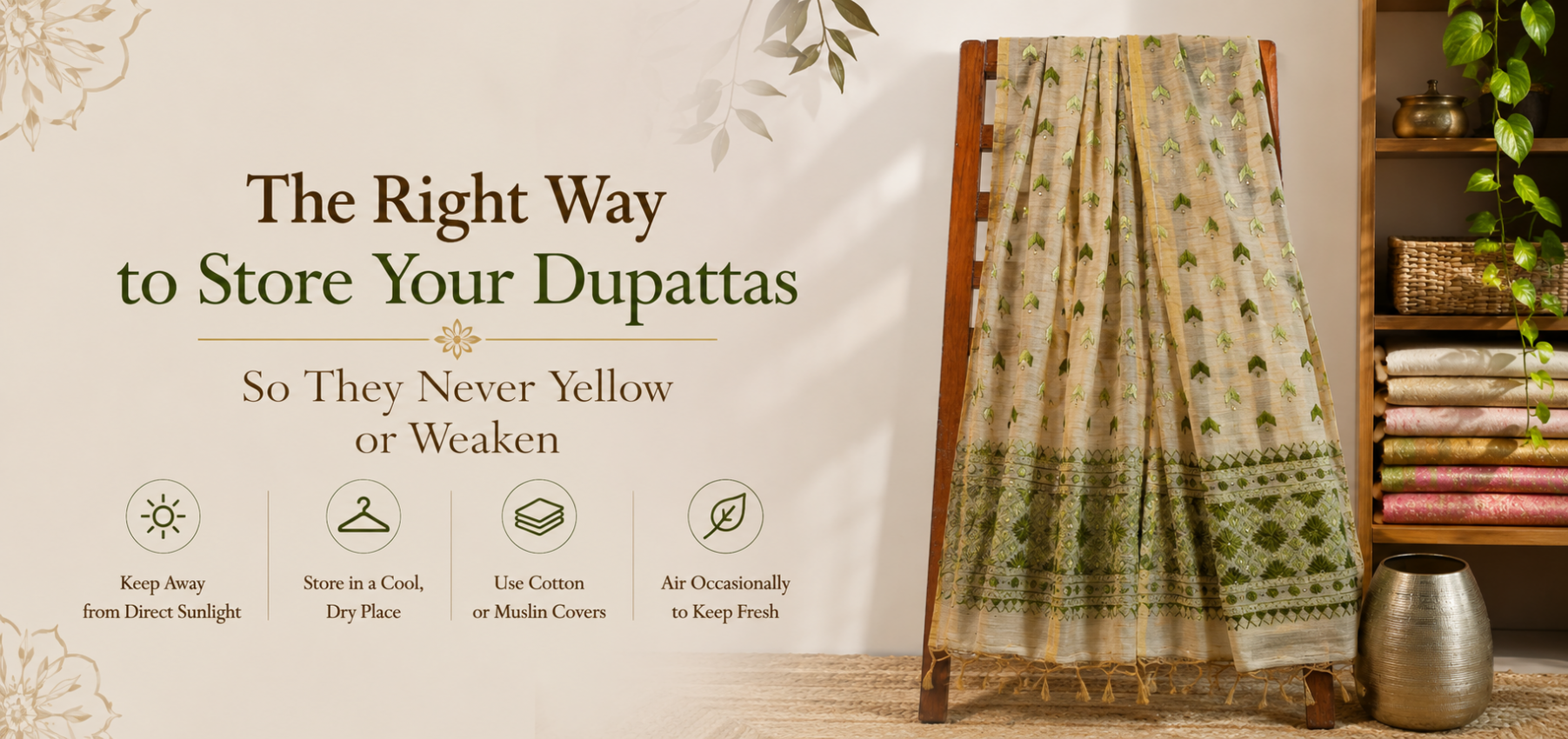
The Right Way to Store Your Dupattas So They Never Yellow or Weaken
A dupatta rarely fails because of how it's worn. It fails because of how it's stored. Heat, humidity, plastic packaging, and poor folding habits are the real reasons a silk or cotton dupatta turns yellow, grows brittle, or loses its sheen within a few years — long before the fabric itself was ever meant to wear out.
How to store dupatta correctly comes down to three fundamentals: breathable packaging, a cool and dry environment, and periodic airing. A dupatta wrapped in plastic or kept in a damp cupboard traps moisture against the fibres, which triggers oxidation, yellow staining, and fibre breakdown — even in fabric that was never worn.
Why Fabric Care Habits Matter Before You Even Think About Storage
Storage problems usually begin at the washing or drying stage, not the cupboard. A dupatta that goes into storage even slightly damp, or one dried under direct sun, starts degrading before it's folded away.
Natural fibres like silk, cotton, and Chanderi cotton-silk blends are protein or cellulose-based. Both react to trapped moisture by developing mildew spots, and both react to direct heat or sunlight by losing colour fastness. This is why textile conservators recommend drying any dupatta fully in shade, never in direct sunlight, before it goes anywhere near a storage box.
Choosing the Right Storage Method for Each Fabric Type
Not every dupatta needs the same storage treatment. Fabric composition decides how much airflow, cushioning, and handling a piece requires.
Silk and Chanderi Silk Dupatta Storage
Silk fibres are protein-based, which makes them sensitive to acidic contact — including contact with ordinary printed paper, wooden shelves, and coloured tissue. A chanderi silk dupatta should be wrapped in acid-free, unbleached muslin cloth rather than plastic or coloured tissue paper, since plastic prevents airflow and accelerates yellowing, while acidic paper can transfer discoloration directly onto the fabric over time.
Fold silk along soft, padded lines rather than sharp creases. A tightly pressed fold weakens the silk fibres at that exact line, and over one or two seasons this becomes a visible crack in the weave.
Cotton and Batik Print Dupatta Storage
Cotton is more forgiving of humidity than silk but is more prone to fading from light exposure. A batik print dupatta, in particular, uses wax-resist dyeing, so it should be stored flat or loosely rolled rather than tightly folded, since sharp folds can crack the dye-resist pattern at the crease over repeated storage cycles.
Handwoven and Zari-Worked Dupatta Storage
Metallic zari threads oxidise faster than the base fabric around them. A handwoven dupatta with zari or metallic border work should be stored with the embellished section facing inward and cushioned with a soft cotton layer, so the metal threads don't rub directly against other fabric or against the storage box itself.
Maheshwari Silk Dupatta Storage
Maheshwari weaves combine silk and cotton yarns, which means they need the moderate-airflow approach used for both fibres — muslin wrapping, shade drying, and avoidance of plastic. A maheshwari silk dupatta with a reversible border pattern also benefits from being folded along the same line each time, since repeated folding at different points weakens the weave unevenly.
Step-by-Step Process to Store Dupatta Without Damage
Following a fixed sequence, rather than an ad-hoc routine, is what actually prevents long-term yellowing and fibre breakdown.
- Wash or air out the dupatta — Even unworn pieces should be aired for a few hours before storage to remove any residual moisture from the last handling.
- Dry fully in shade — Direct sunlight breaks down dye molecules and weakens natural fibres; shade drying preserves both colour and strength.
- Wrap in breathable fabric — Use unbleached muslin or cotton cloth instead of plastic, since plastic traps humidity against the fibres.
- Fold loosely along soft lines — Avoid sharp, repeated creases, especially on embroidered or zari-worked sections.
- Store in a cool, dry, dark space — A wooden almirah lined with cotton cloth performs better than a sealed plastic container.
- Air out every 2-3 months — Unfold, let the fabric breathe for a few hours, then re-fold along a slightly different soft line to prevent permanent crease marks.
Common Storage Mistakes That Cause Yellowing
Most yellowing isn't caused by fabric age — it's caused by preventable storage errors that compound over a few years.
- Sealing fabric in plastic bags: traps humidity and accelerates oxidation, which is the chemical process behind yellow staining.
- Using coloured or printed tissue paper: dyes and inks can transfer onto light-coloured silk during long storage.
- Storing near wooden surfaces without a cotton lining: raw wood releases acidic compounds that discolour fabric over time.
- Ignoring seasonal humidity: monsoon months in most Indian cities raise cupboard humidity significantly, which is when mildew spots appear fastest.
- Never airing stored pieces: fabric left untouched for a year or more traps moisture cycles that weaken fibres invisibly.
Seasonal Storage Adjustments for Indian Climates
India's climate swings between humid monsoons and dry summers, and dupatta storage should adjust accordingly. During monsoon months, adding a silica gel sachet or a few neem leaves inside the storage box helps absorb excess moisture naturally, without the harsh chemical smell of mothballs. In drier winter months, an occasional airing is still useful, since low humidity combined with dust exposure can make silk fibres brittle over time.
Silk vs Cotton vs Handwoven: A Quick Storage Comparison
Fabric Type | Wrapping Material | Fold Style | Main Risk if Stored Wrong |
Silk / Chanderi | Silk / Chanderi | Soft, padded folds | Yellowing, fibre cracking |
Cotton / Batik Print | Breathable cotton cloth | Flat or loose roll | Fading, dye cracking at creases |
Handwoven with Zari | Cotton cushioning around border | Embellishment facing inward | Metallic thread |
Maheshwari Silk | Muslin, moderate airflow | Consistent fold line | Uneven weave weakening |
Expert Insight: What Artisans Say About Fabric Longevity
Weavers working with traditional handloom techniques often point out that the finishing process — the natural dyes, the untreated yarns — makes handcrafted dupattas more climate-sensitive than mass-produced, chemically treated fabric, but also more breathable and less prone to synthetic degradation when stored correctly. This is a key reason handwoven pieces, when cared for with muslin wrapping and shade drying, tend to outlast machine-made equivalents by several years.
Quick Answer: What Is the Right Way to Store a Dupatta?
The right way to store a dupatta is to keep it fully dry, wrapped in breathable cotton or muslin cloth, folded loosely along soft lines, and placed in a cool, dark, low-humidity space — then aired out every two to three months to prevent moisture buildup and permanent creasing.
Frequently Asked Questions
How often should I air out my stored dupattas?
Every 2-3 months is sufficient for most fabrics. Unfold the dupatta, let it sit in shade for a few hours to release trapped humidity, then re-fold along a slightly different line to avoid permanent crease damage.
Can I store silk dupattas in plastic bags?
No. Plastic traps moisture against silk fibres, which speeds up oxidation and yellowing. Use breathable cotton or muslin cloth instead, which allows airflow while still protecting the fabric from dust.
Why do dupattas turn yellow even if they're never worn?
Yellowing usually comes from trapped humidity, contact with acidic materials like raw wood or coloured tissue, or storage in sealed plastic — not from wear. Unworn fabric stored incorrectly can yellow just as fast as worn fabric.
Is it safe to use mothballs to store dupattas?
Traditional mothballs contain naphthalene, which can leave a strong odour and residue on delicate fabrics like silk. Silica gel sachets or dried neem leaves are gentler, natural alternatives that control humidity and pests without chemical residue.
Should handwoven and zari-work dupattas be stored differently from plain ones?
Yes. Metallic zari threads oxidise faster than plain fabric, so the embellished section should face inward and be cushioned with soft cotton to prevent the metal from rubbing against other layers or the storage box.
In Short: Correct dupatta storage rests on four habits: full shade-drying before storage, breathable cotton or muslin wrapping instead of plastic, loose folding along soft lines, and periodic airing every few months. Fabric type changes the specifics — silk needs acid-free wrapping, zari work needs cushioning, cotton prints need flat folding — but the underlying principle stays the same across every weave: moisture and heat are what age a dupatta, not time itself.
-

Which Saree Should I Wear? Easy Choices for Weddings, Office, Festivals & Everyday
September 17th, 2026 -
 August 25th, 2026
 -

What to Wear for Ganesh Chaturthi: Saree Colours and Styling Guide
August 24th, 2026 -
 August 24th, 2026