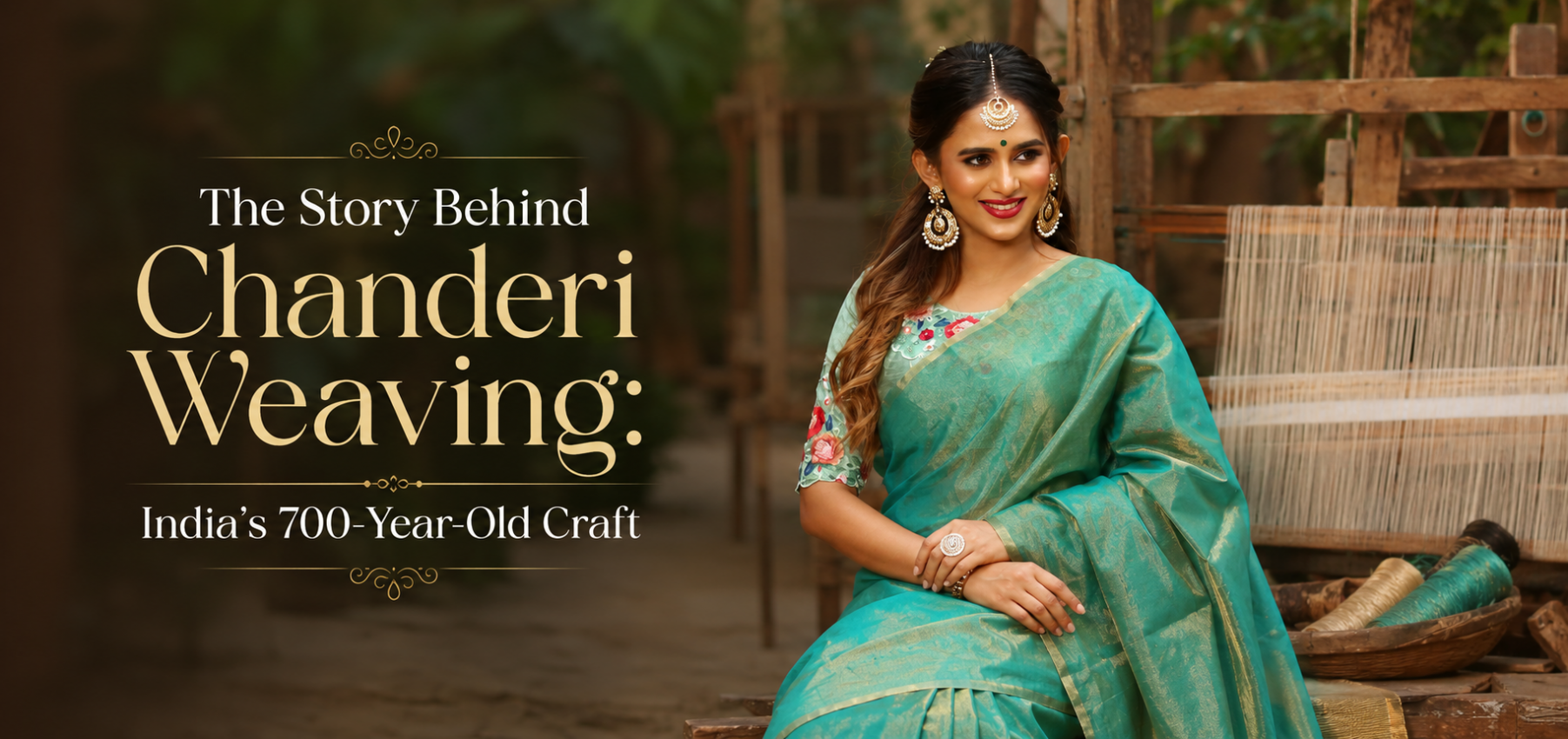
The Story Behind Chanderi Weaving: India's 700-Year-Old Craft
Chanderi weaving history stretches back nearly 700 years to a small town on the Madhya Pradesh–Uttar Pradesh border, where weavers first combined silk and cotton on a single loom to create a fabric unlike any other in India. That fabric — sheer, lightweight, and faintly luminous — is still handwoven today using techniques that have barely changed since the Sultanate period. This piece traces where the craft came from, how it is made, and why it remains one of India's most protected handloom traditions.
What Is Chanderi Weaving?
Chanderi weaving is a handloom technique from Chanderi town in Madhya Pradesh that produces sheer, lightweight fabric using a distinctive blend of silk and cotton yarns. The style is known for its fine texture, transparent finish, and traditional gold or silver zari motifs, such as coins, peacocks, and geometric booti patterns. It received Geographical Indication (GI) status in 2005, formally recognizing it as a product unique to the region.
The Origins: Tracing Chanderi Weaving History to the 13th Century
Chanderi's weaving tradition is generally dated to the 13th century, though local weaving communities are believed to have worked in the region even earlier, during the Vedic and early medieval periods. The town of Chanderi itself sat on a historic trade route connecting Malwa to Mewar and the Deccan, which gave local weavers early access to silk, cotton, and dyeing materials moving along the corridor.
The Koshti weaving community, believed to have migrated to Chanderi from South India, is widely credited with establishing the town's handloom industry in its recognizable form. Over generations, they refined a technique of using cotton in the warp and silk in the weft — a structural choice that gives Chanderi fabric its characteristic sheerness and soft drape, distinct from denser silk weaves produced elsewhere in India.
Chanderi Under the Sultanate and Mughal Patronage
By the 15th and 16th centuries, Chanderi had grown into a significant trading and weaving center under the Malwa Sultanate. Mughal court records and regional chronicles reference Chanderi cloth being used for turbans, garments, and gifting textiles among nobility, which helped establish the fabric's reputation beyond central India. This period is often cited as a turning point in Chanderi weaving history, when the craft moved from a regional trade to one recognized across northern and western India.
Zari work — the metallic thread used in borders and motifs — was introduced more prominently in the 18th and 19th centuries, with gold and silver thread often sourced from Surat. This addition transformed plain Chanderi cloth into the richly bordered fabric associated with the craft today, including pieces still styled as a chanderi silk saree with zari border in contemporary collections.
How Chanderi Fabric Is Made: The Traditional Weaving Process
Authentic Chanderi fabric is still produced almost entirely on pit looms and handlooms, with no shortcuts for the yarn preparation or motif work. The process typically follows these stages:
- Yarn selection: Fine cotton, silk, or a silk-cotton blend is chosen based on the final fabric type.
- Warping: Cotton or silk threads are stretched and aligned on the loom frame, a step that determines the fabric's eventual translucency.
- Dyeing: Yarns are dyed before weaving, traditionally using natural or low-impact dyes to achieve Chanderi's signature soft, muted color palette.
- Weaving: Weavers work the shuttle by hand, interlacing the silk weft with the cotton warp, which is what gives the fabric its sheer, airy quality.
- Motif insertion: Zari booti, coin, and floral patterns are woven in by hand using a technique called extra-weft weaving, rather than printed or embroidered afterward.
- Finishing: The completed length is washed, checked for consistency, and finished — a single saree can take anywhere from a few days to several weeks depending on the complexity of the zari work.
The Three Signature Weaves: Silk, Cotton, and Silk-Cotton
Chanderi is not a single fabric but a family of three related weaves, each suited to different uses and price points. Understanding the difference matters for buyers, since the yarn composition changes how the fabric drapes, breathes, and ages.
Chanderi Silk
Made with pure silk in both warp and weft, this variant has the richest sheen and heaviest drape among the three, often chosen for festive and bridal wear such as a chanderi pure silk saree.
Chanderi Cotton
Woven entirely from fine cotton yarn, this version is breathable and matte-finished, making it a practical choice for daily or office wear in India's warmer months.
Chanderi Silk-Cotton
The original and most traditional blend, using cotton in the warp and silk in the weft, is what gives Chanderi its transparent, glowing texture — a quality also seen in a chanderi silk dupatta or lighter Chanderi stoles.
Why Chanderi Received GI Tag Recognition
Chanderi fabric was granted Geographical Indication status by the Government of India in 2005, legally protecting the name "Chanderi" for textiles woven in and around the town using its traditional techniques. The recognition was aimed at safeguarding weaver livelihoods against power-loom imitations, which had begun replicating the look of Chanderi fabric without the handwoven construction that defines it. A genuine GI-tagged Chanderi piece can typically be traced back to a registered weaving cluster in the Ashoknagar district of Madhya Pradesh.
Chanderi Weaving Today: Artisans and the Push for Revival
Chanderi's weaving community today is smaller than it was in earlier centuries, as power looms and machine-made imitations have drawn buyers away from handwoven cloth in some markets. In response, several state-backed initiatives and independent handloom brands have worked to keep master weavers active by connecting them directly with buyers who specifically seek handwoven, GI-certified fabric rather than mass-produced lookalikes.
Design experimentation has also expanded the craft's range in recent years. Weavers now produce not only traditional sarees and dupattas but also yardage sold as a tissue chanderi fabric or finished as a chanderi tissue saree, where a fine metallic thread is woven throughout the fabric — not just the border — for a subtle, all-over shimmer.
Expert Insight: Reading a Genuine Handwoven Chanderi
Weavers and textile buyers typically check three things before confirming a piece is handwoven: slight irregularities in the weave (a hallmark of hand-shuttle work, not a flaw), the fabric's characteristic transparency when held to light, and hand-inserted zari motifs that feel slightly raised rather than printed flat. Machine-made imitations tend to have a perfectly uniform weave and flat, screen-printed motifs — the absence of any texture is usually the giveaway.
How to Identify Authentic Handwoven Chanderi: A Quick Checklist
- Check for a GI tag or certification from a registered Chanderi weaving cluster.
- Hold the fabric to light — genuine Chanderi has a sheer, glowing translucency.
- Feel the zari motifs; hand-woven booti patterns have slight texture, unlike printed designs.
- Look for minor weave irregularities, which indicate handloom rather than power-loom production.
- Ask about the yarn composition — pure silk, pure cotton, or the traditional silk-cotton blend.
Frequently Asked Questions
How old is the Chanderi weaving tradition?
Chanderi weaving history dates back roughly 700 years to the 13th century, when the Koshti weaving community established the technique in Chanderi town, Madhya Pradesh, though the region's weaving roots may extend even earlier.
What makes Chanderi fabric different from other silk weaves?
Chanderi typically uses cotton in the warp and silk in the weft, which creates a sheer, lightweight, and translucent finish that heavier, pure-silk weaves from other regions do not have.
Is Chanderi fabric handwoven or machine-made?
Authentic Chanderi fabric is handwoven on pit looms by artisans in and around Chanderi town. It carries GI protection, so pieces made on power looms elsewhere cannot legally be labeled as genuine Chanderi.
What are the three main types of Chanderi fabric?
The three main types are Chanderi silk (pure silk), Chanderi cotton (pure cotton), and the traditional Chanderi silk-cotton blend, which is the original and most transparent variety.
How can I tell if a Chanderi saree is genuine?
Look for a GI certification, check that the fabric is sheer when held to light, and feel the zari motifs — hand-woven patterns have slight texture, while printed imitations are flat and perfectly uniform.
In summary: Chanderi weaving history began nearly 700 years ago in a small Madhya Pradesh town, where the Koshti weaving community developed a silk-cotton technique still practiced by hand today. GI-protected since 2005, genuine Chanderi fabric is defined by its sheer texture, hand-inserted zari motifs, and pit-loom construction — qualities no power loom has been able to fully replicate.
-

Which Saree Should I Wear? Easy Choices for Weddings, Office, Festivals & Everyday
September 17th, 2026 -
 August 25th, 2026
 -
What to Wear for Ganesh Chaturthi: Saree Colours and Styling Guide
August 24th, 2026 -
 August 24th, 2026