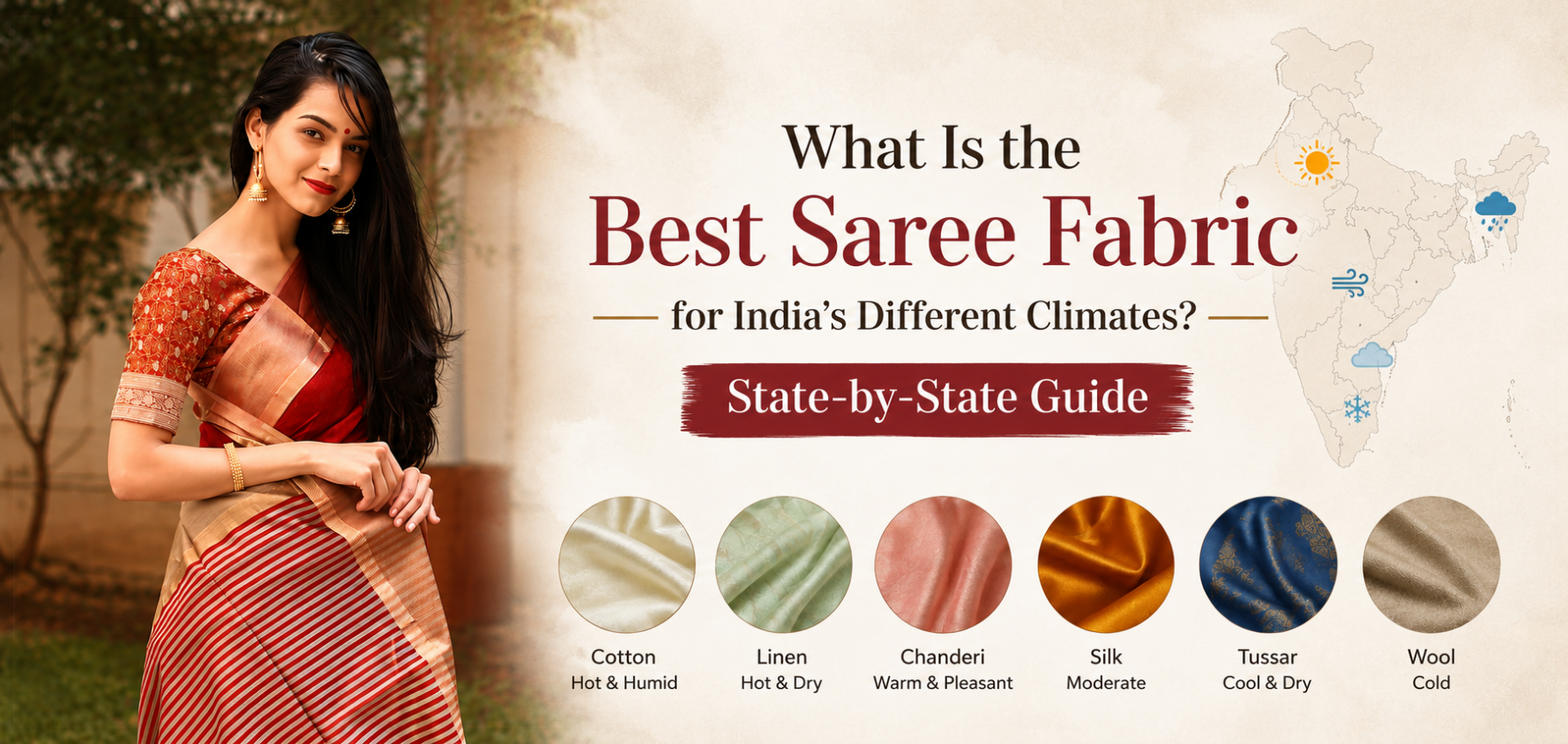
What Is the Best Saree Fabric for India's Different Climates? State-by-State Guide
India's weather never behaves the same way twice — a saree that feels perfect in Jaipur's dry heat can feel unbearable in Kerala's humidity, and a weave that drapes beautifully in Mumbai's monsoon may crease and cling in Kashmir's cold. That's why understanding the best saree fabric for India's different climates isn't just a styling question — it's a practical one that affects comfort, upkeep, and how long a saree lasts in your wardrobe.
This guide breaks India down region by region, explains which natural fibres actually work with each climate, and shows how traditional handloom techniques were designed — centuries ago — to solve exactly this problem.
Why Saree Fabric Choice Matters Across India's Climate Zones
India spans deserts, coastlines, plateaus, and Himalayan foothills, so a single "one fabric fits all" approach rarely works. Fabric affects three things directly:
- Breathability — how well the weave allows air circulation against the skin
- Moisture management — whether the fabric absorbs sweat or traps humidity
- Drape and weight — how the saree falls and how long it stays fresh through the day
Handwoven fabrics like cotton, silk, and tissue have been refined by Indian artisans over generations precisely because each region's weavers adapted their techniques to local weather. That heritage knowledge is still the most reliable guide today.
Understanding India's Broad Weather Zones
Before diving state by state, it helps to group India into four practical climate categories:
- Hot and humid coastal belt — Kerala, Tamil Nadu, coastal Andhra Pradesh, Odisha, West Bengal
- Hot and dry belt — Rajasthan, Gujarat, parts of Haryana and Punjab
- Moderate and seasonal belt — Madhya Pradesh, Maharashtra, Karnataka, Uttar Pradesh
- Cold and hilly belt — Himachal Pradesh, Uttarakhand, Jammu & Kashmir, the Northeastern states
Best Sarees for Hot, Humid Coastal States
In Kerala, Tamil Nadu, coastal Andhra Pradesh, Odisha, and West Bengal, humidity levels stay high through most of the year, so the fabric needs to breathe and dry quickly.
Pure Cotton: The Everyday Choice
Pure cotton is the most trusted choice here. It absorbs perspiration instead of trapping it, feels light against the skin, and dries fast after washing — a real advantage during long humid summers. Handloom cotton sarees from Bengal or Tamil Nadu are worn daily by generations of women for exactly this reason.
Tissue Weaves for Festive Wear
For festive or formal occasions in these states, a handwoven tissue saree is an excellent middle ground. Tissue weaves use fine zari threads with cotton or silk yarn, giving a lightweight shimmer without the heaviness of pure silk — ideal for humid evenings at weddings or temple functions where comfort still matters.
Linen-cotton blends are another rising favourite along the coast, valued for their crisp texture and quick-dry nature during the monsoon-heavy months of these regions.
Best Sarees for Hot and Dry Desert States
Rajasthan and Gujarat experience intense, dry heat for much of the year, with temperatures often crossing 40°C. Here, the fabric priority shifts slightly — you still want breathability, but also a weave that reflects heat rather than absorbing it.
Lightweight cotton and cotton-silk blends work best in this belt. A pure maheshwari silk saree, in particular, is well suited to this region's climate — it originates from Madhya Pradesh but shares the dry-belt sensibility, combining silk's smooth drape with a cotton warp that keeps the fabric light and cool rather than clingy.
Block-printed cottons, a specialty of Rajasthan and Gujarat, are also a natural fit — the loose cotton weave paired with natural dyes keeps the saree breathable while celebrating the region's own textile tradition.
Best Sarees for Moderate and Seasonal States
States like Madhya Pradesh, Maharashtra, and Karnataka experience a more balanced climate — warm summers, moderate monsoons, and cooler winters — which opens up more fabric flexibility through the year.
Maheshwari Silk: Light Yet Elegant
This is where Maheshwari silk sarees truly shine. Woven along the banks of the Narmada in Maheshwar, these sarees blend silk and cotton yarns, making them light enough for daytime wear yet elegant enough for festive occasions. If you're exploring maheshwari silk sarees online, this region's moderate climate is a good benchmark for how versatile the fabric really is — equally comfortable at a summer function or a winter wedding.
Chanderi Silk: Featherlight Sheen
Chanderi fabric, from the Chanderi belt of Madhya Pradesh, is another regional specialty suited to this zone. Its signature sheer, glossy texture — especially a chanderi silk saree with zari border — offers a featherlight feel that works beautifully in transitional weather, neither too hot nor too cold.
Best Sarees for Cold and Hilly Regions
In Himachal Pradesh, Uttarakhand, Jammu & Kashmir, and the Northeastern hill states, temperatures drop significantly, especially in winter, so warmth becomes the priority alongside elegance.
Pure silk and tussar silk sarees are the traditional choice here. Silk fibres naturally retain body heat far better than cotton, making them ideal for cooler evenings and winter celebrations. In the Northeast, states like Assam add locally woven silks such as Muga and Eri, prized for their natural warmth and durability.
For daily wear in colder months, heavier cotton-silk blends with a slightly thicker weave provide a practical balance between warmth and comfort, without the bulk of pure wool drapes.
Best Sarees for the Monsoon Season, Nationwide
Regardless of state, monsoon months call for fabric that resists moisture damage and dries quickly. Synthetic-cotton blends and batik print sarees are especially popular during this season — the wax-resist dyeing technique used in batik print sarees online collections produces vibrant, water-tolerant patterns on breathable cotton, making them a smart monsoon-friendly pick across most of the country.
Pure silk, while beautiful, is best kept for dry, indoor festive occasions during the monsoon, since silk fibres can be sensitive to prolonged dampness.
Quick Reference: Fabric by Climate Zone
Climate Zone | States | Recommended Fabric |
Hot & Humid Coastal | Kerala, Tamil Nadu, Odisha, West Bengal | Cotton, handwoven tissue |
Hot & Dry Desert | Rajasthan, Gujarat | Maheshwari silk, block-printed cotton |
Moderate/Seasonal | Madhya Pradesh, Maharashtra, Karnataka | Chanderi silk, Maheshwari silk |
Cold & Hilly | Himachal, Uttarakhand, J&K, Northeast | Pure silk, tussar silk |
Monsoon (Pan-India) | All states | Batik cotton, synthetic-cotton blends |
How to Choose the Right Saree Fabric for Your Climate
When shopping for the best saree fabric for India's different climates, keep these practical checkpoints in mind:
- Match fabric weight to season — lighter cotton and tissue for summer, silk for winter
- Check the weave, not just the fibre — a loosely woven cotton breathes better than a tightly woven one
- Consider your daily routine — office wear favours low-maintenance cotton; festive wear allows for silk or zari work
- Factor in humidity, not just temperature — coastal buyers should prioritise moisture-wicking fabrics over pure silk
Why Handwoven and Handcrafted Sarees Work Better in Every Climate
Machine-made fabrics are engineered for uniformity, but handloom weaves are shaped by the weaver's understanding of yarn tension, humidity, and regional temperature — which is why traditional handcrafted sarees often perform better season after season than mass-produced alternatives. Every small irregularity in a hand-woven thread is part of what makes the fabric breathe naturally and age gracefully.
Choosing from a curated collection of handcrafted sarees online also means supporting the artisan communities who have preserved these climate-smart weaving techniques for generations — from Maheshwari and Chanderi weavers in Madhya Pradesh to block-print artisans in Rajasthan and Gujarat.
Conclusion
There's no single "best" saree fabric for the whole country — the right choice depends on where you live, the season, and the occasion. Cotton and tissue suit humid coastal states, Maheshwari and Chanderi silk suit dry and moderate zones, pure silk suits cold hill regions, and batik-printed cotton carries you through the monsoon almost anywhere in India. Understanding these regional patterns helps you build a saree wardrobe that stays comfortable, elegant, and long-lasting through every Indian season.
Frequently Asked Questions
1. Which saree fabric is best for humid weather in India?
Pure cotton and handwoven tissue sarees are best for humid weather, as they absorb moisture, allow airflow, and dry quickly compared to heavier silk weaves.
2. Is silk saree suitable for summer?
Lightweight silk-cotton blends, such as Maheshwari silk, work reasonably well in summer, but pure heavy silk is better saved for cooler months or air-conditioned settings.
3. What is the best saree fabric for Rajasthan's dry heat?
Cotton, block-printed cotton, and Maheshwari silk-cotton blends work well in Rajasthan, as they stay breathable while suiting the region's dry climate.
4. Which saree fabric is warmest for winter or hilly regions?
Pure silk and tussar silk sarees are the warmest options, making them ideal for Himachal Pradesh, Uttarakhand, Jammu & Kashmir, and the Northeastern hill states.
5. Are handwoven sarees better than machine-made ones for changing climates?
Yes, handwoven sarees are generally more breathable and durable across seasons because artisans naturally adjust the weave's tightness and yarn quality to suit regional weather conditions.
-
Which Saree Should I Wear? Easy Choices for Weddings, Office, Festivals & Everyday
September 17th, 2026 -
 August 25th, 2026
 -
What to Wear for Ganesh Chaturthi: Saree Colours and Styling Guide
August 24th, 2026 -
 August 24th, 2026