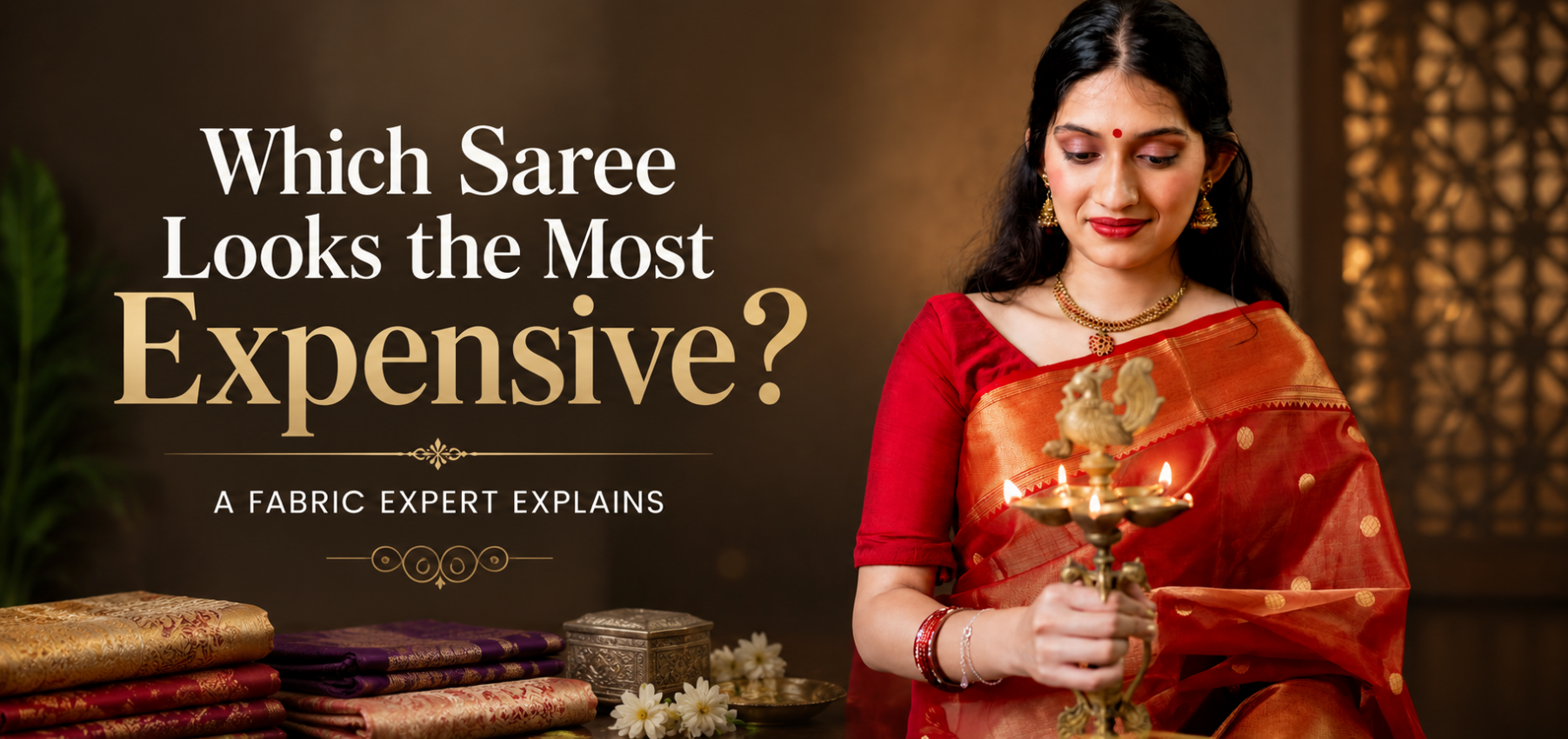
Which Saree Looks the Most Expensive? A Fabric Expert Explains
Why two sarees of the same colour can look worlds apart — and how to spot the difference before you buy.
If you have ever stood in front of a mirror wondering why one saree looks like it belongs on a red carpet while another, just as brightly coloured, looks ordinary, the answer almost never lies in the price tag. It lies in the fabric, the weave, and the way light moves across the cloth.
Quick AnswerA saree looks the most expensive when it combines a natural fibre (silk or fine cotton), a visible handwoven texture, a fluid drape, and understated zari or border detailing. Fabrics like Maheshwari silk, Chanderi silk, handwoven tissue, and hand-block batik cotton consistently photograph and drape richer than synthetic alternatives, regardless of price.
In this guide, we break down exactly what separates a luxury looking saree from an ordinary one — the science of drape, the role of weave density, why handloom always reads richer than power-loom, and how to identify these markers before you buy. Think of this as the checklist a textile expert would run through before recommending a saree for a wedding, a boardroom, or a festival.
What Actually Makes a Saree Look Expensive?
Before we get into individual fabrics, it helps to understand the four factors that consistently signal luxury to the human eye, whether the saree costs two thousand rupees or two lakh.
- Fibre quality – Natural fibres like mulberry silk, tussar silk, and long-staple cotton catch and reflect light differently than synthetic blends. This reflection is what people unconsciously read as “richness.”
- Weave texture – A handwoven saree has micro-irregularities in the thread tension that create depth and shadow across the surface. Machine-made fabric, by contrast, looks flat under light.
- Drape and fall – Fabric that skims the body and moves with each step looks considerably more expensive than fabric that sits stiff or clings unnaturally.
- Detailing restraint – Contrary to popular belief, an overloaded saree with excessive embellishment often looks cheaper than one with a single well-placed zari border. Luxury looking sarees tend to let the fabric do the talking.
Keep these four markers in mind as we go through specific fabrics, because they explain why certain weaves outperform others in the “expensive” test.
Silk: Still the Benchmark for Luxury
There is a reason silk remains the default answer whenever someone asks which fabric looks the richest. Silk fibres are naturally triangular in cross-section, which means they bend light at multiple angles and produce that characteristic sheen no synthetic fabric can fully replicate.
Within silk, handloom varieties consistently outperform power-loom silk in the “does this look expensive” test. A pure Maheshwari silk saree is a good example — woven on the banks of the Narmada using a technique that dates back centuries, it has a distinctive reversible border and a silk-cotton blend that gives it body without heaviness. The subtle sheen, rather than an aggressive shine, is precisely what reads as tasteful luxury instead of costume glamour.
Chanderi and Handwoven Tissue: Where Lightness Meets Luxury
Not every luxury looking saree needs to be heavy. Some of the richest-looking drapes in Indian textile tradition are also the lightest.
A chanderi silk saree with zari border is woven from a blend of silk and cotton so fine that the fabric becomes almost translucent, while the zari border anchors the design with just enough shimmer to signal craftsmanship. Because the fabric is sheer, every fold catches light differently, giving the saree a glow that heavier fabrics cannot achieve.
Similarly, a handwoven tissue saree uses a metallic weft thread running through the fabric, which produces an all-over golden shimmer rather than shine concentrated only on the border. This is why tissue sarees are a wedding-season favourite — under festive lighting, the fabric appears to glow from within rather than simply reflecting light off the surface.
Why Handloom Always Photographs Richer Than Machine-Made Fabric
If you have ever compared two sarees of similar colour and pattern online — one handloom, one machine-made — and instinctively felt one looked “more expensive,” you were responding to weave density and thread irregularity.
Handloom weaving involves a human hand adjusting tension, thread by thread, row by row. This creates minute variations that catch light unpredictably, giving the fabric visual depth. Machine looms, by contrast, produce perfectly uniform tension, which results in a flatter, more one-dimensional surface — even when the pattern is identical.
This is also why handcrafted sarees online tend to command more attention in photographs and in person. The “imperfections” of handloom are not flaws; they are the visual signature of craftsmanship, and they are the single biggest reason two similarly priced sarees can look worlds apart.
The Colour and Print Factor: Batik and Hand-Block Work
Colour depth plays as large a role as fabric in determining how expensive a saree looks. Machine-printed sarees often use flat, uniform colour, which can look mass-produced regardless of the shade chosen. Hand-applied dyeing techniques solve this problem entirely.
A batik print cotton saree is created using a wax-resist dyeing process applied by hand, then dipped in natural colour baths, sometimes across multiple layers. The result is a saree where no two motifs are perfectly identical, and the colour has visible depth rather than a single flat tone. This layered, slightly imperfect finish is precisely what separates a hand-block print from a digital print — and it is a detail experienced eyes pick up on instantly.
Common Mistakes That Make a Saree Look Cheaper Than It Is
Even a genuinely good fabric can be let down by styling choices. A few patterns worth avoiding:
- Overdoing the blouse. A heavily embellished blouse paired with an already ornate saree competes for attention instead of complementing it.
- Wrong pleats for the fabric. Stiff fabrics need structured pleats; soft, fluid fabrics like tissue or Chanderi look best with looser, more natural draping.
- Too much jewellery. Layering multiple heavy pieces over a detailed saree border creates visual clutter rather than richness.
- Ignoring fabric weight for the occasion. A stiff, heavy fabric under harsh daytime light can look costume-like, while the same saree glows beautifully under evening or festival lighting.
How to Style Luxury Looking Sarees Without Overspending
You do not need the most expensive fabric in the market to achieve a rich, elevated look. A few professional styling principles go a long way:
- Let the fabric lead. If the saree has a strong weave or print, keep the blouse and accessories minimal.
- Choose jewel tones or metallics — emerald, maroon, mustard, and deep indigo photograph richer than pastel shades under most lighting.
- Iron with care. Silk and tissue fabrics should be pressed on the reverse side at low heat to preserve sheen.
- Invest in the drape, not just the saree. A well-pleated pallu can make even a simple cotton saree look considerably more polished.
A Simple Buying Checklist Before You Purchase
When shopping for luxury looking sarees, whether online or in-store, run through this checklist:
- Check the fabric composition on the product description — pure silk, silk-cotton blends, or handloom cotton generally outperform synthetic blends.
- Ask whether the piece is handwoven or hand-printed rather than machine-made.
- Look closely at the border and zari work in product photos — genuine zari has a slightly duller, warmer metallic tone compared to synthetic zari, which looks brighter but flatter.
- Read the weaving region mentioned by the seller — Chanderi (Madhya Pradesh), Maheshwar (Madhya Pradesh), and Varanasi (Uttar Pradesh) each have distinct, traceable weaving traditions.
- When exploring maheshwari silk sarees online, prioritise sellers who disclose the artisan cluster and weaving technique, since transparency is usually a good indicator of authenticity.
Final Word
A saree does not need a designer label or a six-figure price to look expensive. What it needs is a fabric with genuine texture, a weave that carries the mark of a human hand, and colours with real depth rather than flat print. Silk, Chanderi, handwoven tissue, and hand-block batik cotton consistently outperform synthetic alternatives on every one of these markers — which is exactly why they remain the most trusted choices for anyone who wants a saree that looks, and feels, genuinely luxurious.
Frequently Asked Questions
Which fabric makes a saree look the most expensive?
Pure silk and handwoven fabrics such as Maheshwari silk, Chanderi silk, and handwoven tissue consistently look the richest because their natural fibres and hand-tension weaving create depth and sheen that machine-made or synthetic fabrics cannot replicate.
Can a cotton saree look as expensive as a silk saree?
Yes. Handwoven and hand-block printed cotton sarees, such as batik print cotton sarees, can look equally luxurious because the visual richness comes from texture, colour depth, and craftsmanship rather than the fibre alone.
How can I tell if a saree is genuinely handwoven and not machine-made?
Look for subtle irregularities in the weave, a slightly uneven border tension, and a soft, non-uniform texture. Machine-made fabric tends to look perfectly flat and repetitive, while handloom fabric shows minor natural variation.
Does a heavier saree always look more expensive?
No. Lightweight fabrics like Chanderi and tissue silk often look more luxurious than heavier fabrics because they drape closer to the body and reflect light more dynamically with movement.
What styling mistakes make an expensive saree look cheap?
Overloading the outfit with a heavily embellished blouse, excessive jewellery, or incorrect pleating for the fabric type are the most common mistakes that undercut an otherwise luxurious saree.
-
Which Saree Should I Wear? Easy Choices for Weddings, Office, Festivals & Everyday
September 17th, 2026 -
 August 25th, 2026
 -
What to Wear for Ganesh Chaturthi: Saree Colours and Styling Guide
August 24th, 2026 -
 August 24th, 2026