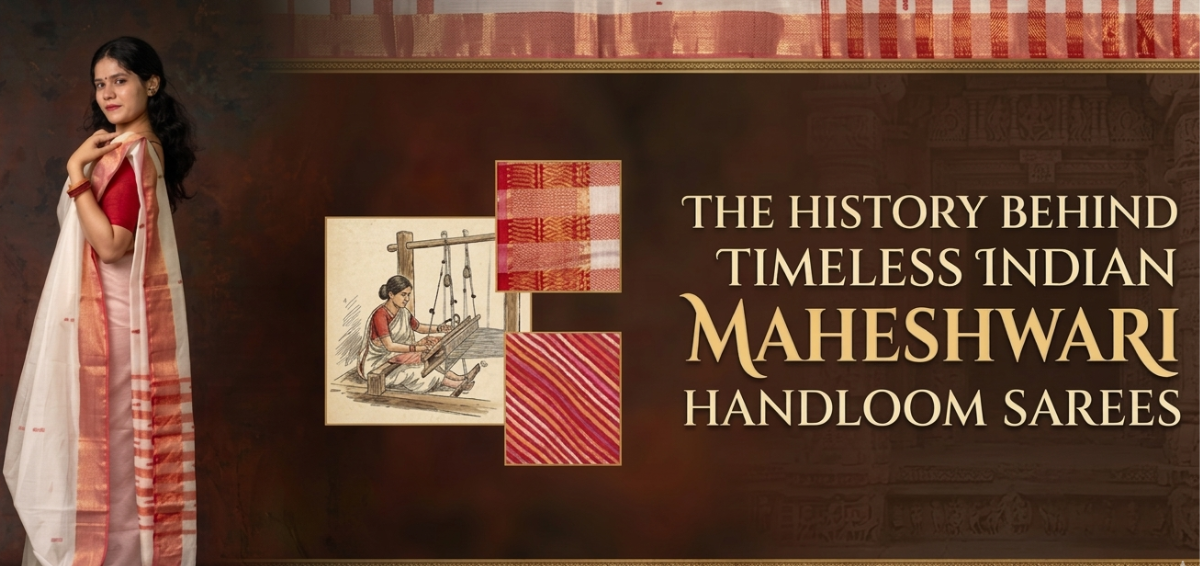
The History Behind Timeless Indian Maheshwari Handloom Sarees
In the heart of central India, where the sacred Narmada River flows past the stone ghats of Maheshwar, a textile legacy was born that would redefine Indian elegance. The Maheshwari handloom saree is not just a garment; it is a storied tapestry of royal vision, architectural inspiration, and artisanal resilience. Today, as the world pivots toward sustainable slow fashion, the Maheshwari weave stands as a beacon of ethical luxury and timeless style.
For the modern woman seeking Handcrafted Sarees Online, understanding the roots of this craft adds a layer of soul to every drape. From the 18th-century courts of a visionary queen to the global ramps of today, let’s uncover the glorious history of the Maheshwari silk saree.
The Royal Origin: Rani Ahilyabai Holkar’s Vision
The story of the Maheshwari saree begins with one of India’s most revered rulers, Rani Ahilyabai Holkar. In the late 1700s, the Queen of the Maratha Malwa kingdom moved her capital to the riverside town of Maheshwar. Her goal was twofold: to create a dignified attire for the royal ladies and to provide a sustainable livelihood for her people.
She invited master weavers from Mandu and Surat to settle in Maheshwar, tasking them with creating a fabric that was as lightweight as it was regal. The first 9-yard wonders were designed by the Queen herself to be gifted to royal guests and dignitaries. This royal patronage ensured that every Pure Maheshwari Silk Saree produced in the town carried an inherent sense of nobility and grace.
Architecture Woven in Silk: The Design Language
What makes a Maheshwari saree instantly recognizable is its design vocabulary. Unlike the floral-heavy motifs of Banaras, Maheshwari weaves are deeply influenced by the Maheshwar Fort and its surrounding temples.
The Iconic Borders and Motifs
- Leheriya: Inspired by the ripples of the Narmada River.
- Chatai: A mat-like pattern reflecting the stone carvings of the fort.
- Chameli: Delicate jasmine flower motifs.
- Eent: A brick pattern inspired by local architecture.
One of the most unique technical features of these sarees is the Bugdi or reversible border. This allows the wearer to drape the saree from either side, a testament to the ingenious engineering of the traditional pit looms used by local artisans.
Understanding the Weave: What is a Garbh Reshmi Maheshwari Saree?
To the uninitiated, all silk-cottons may look the same, but the Garbh Reshmi Maheshwari Saree holds a special place in the hierarchy of handlooms. The term "Garbh Reshmi" literally translates to "silk in the womb" or "silk at the core."
The Technical Composition
In a true Garbh Reshmi weave, the warp (Tana) consists of pure silk threads, while the weft (Bana) is made of fine mercerized cotton. This specific blend creates a fabric that has the lustrous sheen of silk but the breathable comfort of cotton. It is this unique ratio that makes Maheshwari Silk Sarees Online a favorite for the Indian climate—keeping you cool in the summer and elegant during winter festivities.
The Handloom vs. Powerloom Gap: Why Authenticity Matters
As demand grows, the market is often flooded with machine-made imitations. However, for a brand like Thread's Tale, the focus remains on the "human touch." Statistics from the Handloom Export Promotion Council (HEPC) suggest that the handloom sector is the second-largest employer in rural India, supporting over 4.3 million people. Choosing a handcrafted piece directly impacts these livelihoods.
| Authentic Handloom | Mass-Produced Powerloom | |
Texture |
| Stiff or overly "plasticky" sheen | |
Edges | Slightly irregular (sign of hand-weaving) | Perfectly uniform and sharp | |
Zari Quality | Subtle, deep glow that doesn't tarnish easily | High-glare, often turns black over time | |
Longevity | Grows softer with every wash; lasts decades | Fibers weaken quickly after a few wears |
Maheshwari Sarees as the Soul of Sustainable Slow Fashion
In an era of "fast fashion" where trends change weekly, the Maheshwari saree is a symbol of Sustainable Slow Fashion. A single Pure Maheshwari Silk Saree can take anywhere from 3 to 7 days to weave on a traditional pit loom. This slow, meticulous process ensures minimal carbon footprint as it relies entirely on human energy rather than electricity.
At Thread's Tale, sustainability isn't just a buzzword; it's the foundation of our USP. By using natural dyes and supporting artisan empowerment, we ensure that every saree is an eco-conscious investment. When you buy Handcrafted Sarees Online, you aren't just buying clothes; you are preserving a 250-year-old ecological heritage.
How to Care for Your Heritage Weaves
To ensure your Maheshwari Silk Sarees Online remain as vibrant as the day they were woven, follow these professional care tips:
- Dry Clean First: For the first few washes, professional dry cleaning is recommended to lock in the colors.
- Avoid Direct Sunlight: Always dry your handloom sarees in a shaded, airy area to prevent the natural dyes from fading.
- Refolding: Do not let the saree sit in the same fold for months. Refold it every 3 months to prevent "cut-marks" along the creases.
- Use Muslin Bags: Store your silk sarees in breathable muslin or cotton covers rather than plastic bags.
Conclusion: A Wearable Story of India
The history of the Maheshwari handloom is a reminder that fashion can be both royal and responsible. From the banks of the Narmada to the digital storefront of Thread's Tale, these sarees continue to weave people together across generations. Whether it is a wedding, a festive celebration, or a professional meeting, a Maheshwari saree provides a sophisticated edge that machine-made garments simply cannot replicate.
Explore our curated collection of Pure Maheshwari Silk Sarees and become a part of this timeless Indian story.
Frequently Asked Questions (FAQs)
1. What is the difference between a Chanderi and a Maheshwari saree?
While both are from Madhya Pradesh, Chanderi sarees are known for their sheer, "Bootee" (floral/coin) motifs and paper-like texture. Maheshwari sarees are typically more linear, featuring geometric borders and a more fluid, reversible drape.
2. How can I check the purity of a Maheshwari Silk Saree?
Look for the 'Silk Mark' certification for the yarn. Additionally, feel the fabric—it should be lightweight and slightly cool to the touch. Authentic handlooms will have minor, almost invisible irregularities in the weave which prove they weren't made by a machine.
3. Why are Maheshwari sarees considered "Slow Fashion"?
They are considered Sustainable Slow Fashion because they are manually woven on looms that require no electricity. The production process respects the pace of the artisan and uses eco-friendly materials, resulting in a product built to last for generations.
4. Can I wear a Maheshwari silk-cotton saree in the summer?
Absolutely! The cotton weft in the Garbh Reshmi and other blends makes these sarees highly breathable and sweat-absorbent, making them the perfect year-round ethnic wear for the Indian climate.
5. Is Thread's Tale an authentic source for Handcrafted Sarees Online?
Yes, Thread's Tale specializes in authentic, artisan-sourced handlooms. We prioritize direct collaboration with weaving clusters to ensure that every piece is 100% handcrafted and ethically produced.
-
Which Saree Should I Wear? Easy Choices for Weddings, Office, Festivals & Everyday
September 17th, 2026 -
 August 25th, 2026
 -
What to Wear for Ganesh Chaturthi: Saree Colours and Styling Guide
August 24th, 2026 -
 August 24th, 2026