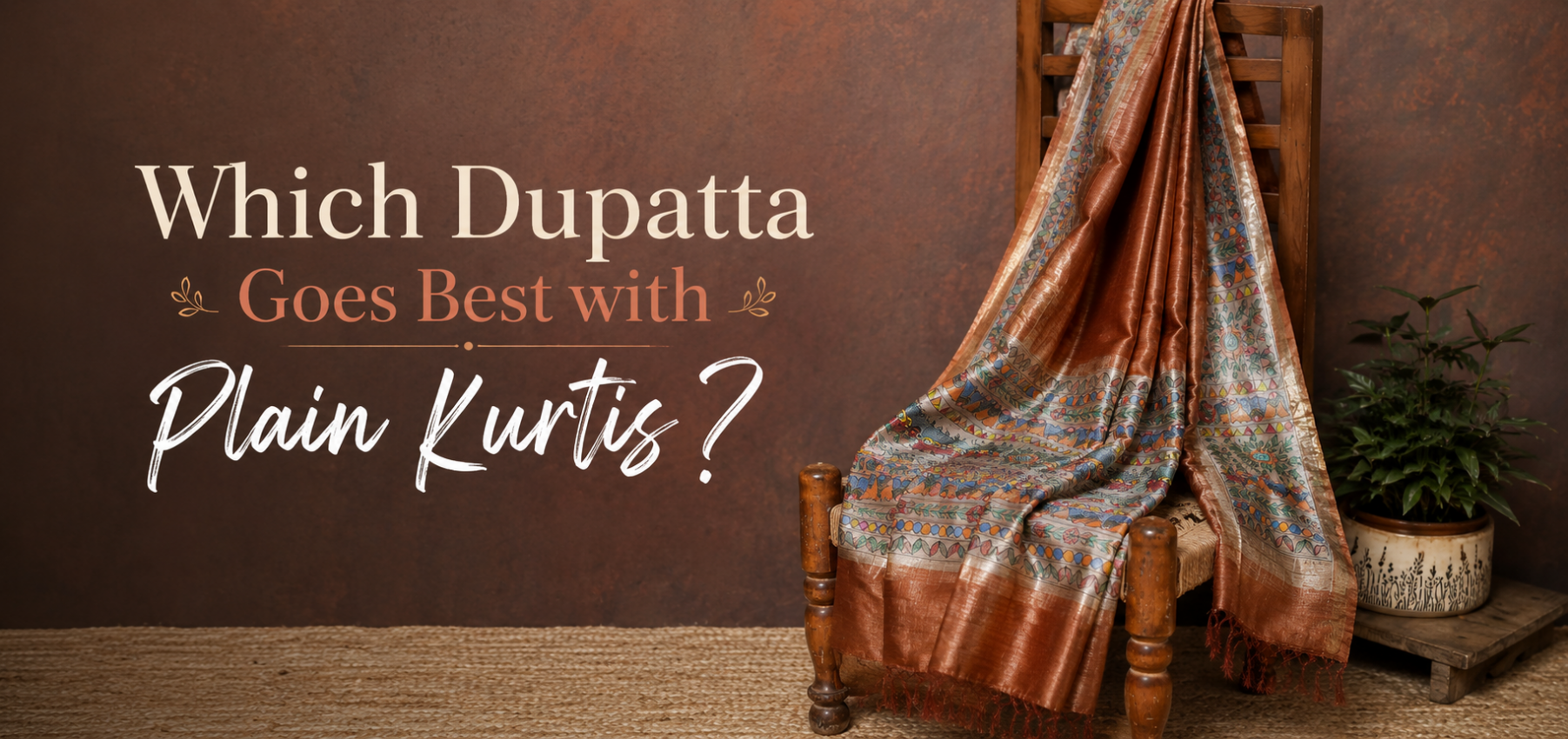
Which Dupatta Goes Best with Plain Kurtis?
If you've ever stood in front of your wardrobe holding a plain kurti and wondering what to throw over it, you're not alone. It's one of the most commonly searched ethnic styling questions in India, and for good reason — a plain kurti is the easiest piece to build ten different looks from, but only if you get the dupatta right. Get it wrong, and even a beautifully tailored kurti can look unfinished or, worse, mismatched.
The good news is that choosing the right dupatta for plain kurti outfits isn't about luck or trend-chasing. It comes down to three simple factors: fabric weight, colour logic, and occasion. Once you understand these, picking a dupatta becomes instinct rather than guesswork — and a few handwoven options do more heavy lifting than the rest.
Why a Plain Kurti Needs Its Dupatta to Work Harder
A printed or embroidered kurti already has a story to tell, so its dupatta can afford to stay quiet. A plain kurti has no such advantage — the dupatta becomes the single biggest style decision in the outfit. This is exactly why so many women default to safe, forgettable pairings: a plain kurti with a plain dupatta in a slightly different shade. It isn't wrong, but it rarely looks intentional.
The better approach is to treat your plain kurti as a blank canvas and let the dupatta bring texture, motif, or sheen — the visual interest the outfit is otherwise missing. Once you start thinking this way, deciding what goes with a plain kurti stops feeling like a daily dilemma.
Start With Fabric Weight, Not Colour
Most styling mistakes happen because people choose colour first and fabric second — it should really be the other way around. A heavy, stiff dupatta on a soft cotton kurti sits awkwardly and pulls at the shoulders, while a sheer, flowy dupatta on a structured kurti can look thin and underwhelming next to it.
For daily plain cotton or linen kurtis, lightweight handloom cotton or silk-cotton dupattas drape naturally without adding bulk, and hold their pleats through a full day at work or college. For festive plain kurtis in silk or Chanderi, a slightly richer silk dupatta balances the fabric weight and feels intentional rather than mismatched. Getting this one decision right solves more than half of the styling puzzle.
The Festive Lift: Silk Dupattas That Transform a Plain Kurti
A plain kurti in soft pastels or solid jewel tones is the easiest base to dress up for festive occasions — and the dupatta does almost all the work here. Reversible silk weaves with woven borders add structure and richness without competing with the kurti's simplicity.
A maheshwari silk dupatta is particularly suited to this role. Its reversible weave means both sides look finished, its woven motifs add visual interest without needing embroidery, and its lightweight body keeps it comfortable through long festive days. Draped over a plain silk or cotton kurti in a contrasting jewel tone, it instantly reads as dressed-up without requiring any additional embellishment elsewhere in the outfit.
The Everyday Elegant Pairing: Lightweight Silk for Office and Daily Wear
Not every plain kurti needs festive drama. For office wear, college, or daily errands, the goal is polish without effort — and this is exactly where gossamer-light weaves earn their place.
A chanderi silk dupatta works beautifully here because its sheer texture and subtle zari edge add a quiet sheen to a plain kurti without making the outfit feel overly formal. It's breathable enough for long days, light enough to drape in seconds, and refined enough to move from a morning meeting to an evening dinner without a wardrobe change. For plain kurtis in neutral or pastel shades, this pairing consistently looks more put-together than a printed or sequinned alternative.
Adding Colour and Character With Hand-Painted Print
If your plain kurti wardrobe is mostly solids, the easiest way to bring in colour, pattern, and personality is through the dupatta — not the kurti itself. This is where artisanal print techniques outperform anything mass-printed.
A batik print dupatta brings exactly this kind of character. Because every piece is hand-dyed using a wax-resist technique, no two motifs are identical, which means a plain kurti instantly looks curated rather than basic. Pair an earthy batik dupatta with a solid cotton kurti in cream, olive, or rust, and you get an artisanal look that works just as well for a Sunday brunch as it does for a casual office Friday.
When Authenticity Matters More Than the Occasion
Some days, the goal isn't festive or formal — it's simply wearing something that feels genuinely made, not mass-produced. This is where handwoven craftsmanship becomes the actual selling point of the outfit, rather than colour or print.
Exploring a curated handwoven dupatta collection makes this easy, since each piece — whether Maheshwari, Chanderi, or Tussar — carries the slight, intentional irregularities that machine-made dupattas simply cannot replicate. Paired with a plain kurti, these small imperfections become the focal point of the outfit, turning a simple combination into something that feels personal and considered rather than thrown together.
Colour Pairing Rules That Work With Almost Any Plain Kurti
Once fabric is sorted, colour is the easier half of the decision. Three approaches consistently work for a dupatta for plain kurti pairing:
- Tone-on-tone: a dupatta in a slightly deeper or lighter shade of the kurti colour creates a sleek, elongating look — ideal for formal settings.
- Deliberate contrast: complementary shades like mustard with indigo, or rust with teal, add energy without looking chaotic, and work well for festive day events.
- Print-on-plain: a richly patterned or hand-painted dupatta over a solid kurti lets the print carry the visual weight, which is the safest rule for anyone unsure where to start.
Pick one rule per outfit — mixing more than one usually overcomplicates a simple kurti.
How to Drape It So the Dupatta Does the Talking
Even the right dupatta can underwhelm with the wrong drape. For a plain straight-cut kurti, a front V-drape keeps the front clean and lets a patterned border show on both sides. For A-line or Anarkali-style plain kurtis that already have volume, a single-shoulder drape avoids adding bulk. If you're wearing a richer silk dupatta for a festive look, a cape-style drape pinned at the shoulders lets the full motif and border show, turning the dupatta into the outfit's main visual feature instead of an afterthought.
A Quick Occasion-Wise Guide
- Office or college: lightweight Chanderi or handloom cotton, styled tone-on-tone.
- Festive function: reversible Maheshwari silk in a contrasting jewel tone.
- Casual weekend: hand-painted batik in earthy tones.
- Gifting or special memory: a handwoven heirloom piece in any weave.
The Real Answer Isn't One Dupatta — It's the Right One for the Day
There's no single "best" dupatta for every plain kurti, and any guide that claims otherwise is oversimplifying. What actually works is matching fabric weight to the occasion, choosing one colour rule and sticking to it, and leaning on handwoven craftsmanship whenever you want the outfit to feel considered rather than convenient. Once these basics become instinct, dressing up — or down — a plain kurti stops being a daily puzzle and becomes one of the easiest styling decisions in your wardrobe.
Frequently Asked Questions
Which dupatta is best for a plain cotton kurti?
Lightweight handloom cotton or a sheer Chanderi weave works best for a plain cotton kurti. Both drape naturally without adding weight, making them ideal for daily wear, office days, and casual outings.
Should a dupatta match or contrast with a plain kurti?
Both work, depending on the occasion. Matching tones create a sleek, formal look, while contrasting jewel tones add festive energy. Pick one approach per outfit rather than mixing both for a cleaner finish.
Can silk dupattas be worn with simple, everyday kurtis?
Yes, lightweight silk weaves like Chanderi are breathable and comfortable enough for daily wear, while adding a subtle sheen that elevates even the simplest cotton kurti without making the outfit feel overly formal.
What is the easiest dupatta drape for plain kurtis?
The one-shoulder drape is the easiest and most versatile option for plain kurtis. It requires minimal styling, works for both straight-cut and A-line silhouettes, and suits daily as well as semi-festive occasions.
Are printed dupattas a good match for plain kurtis?
Yes, printed or hand-painted dupattas, such as batik prints, are an excellent match for plain kurtis. They let the dupatta carry the visual interest, instantly making a simple, solid-coloured outfit look curated and complete.
-
Which Saree Should I Wear? Easy Choices for Weddings, Office, Festivals & Everyday
September 17th, 2026 -
 August 25th, 2026
 -
What to Wear for Ganesh Chaturthi: Saree Colours and Styling Guide
August 24th, 2026 -
 August 24th, 2026