

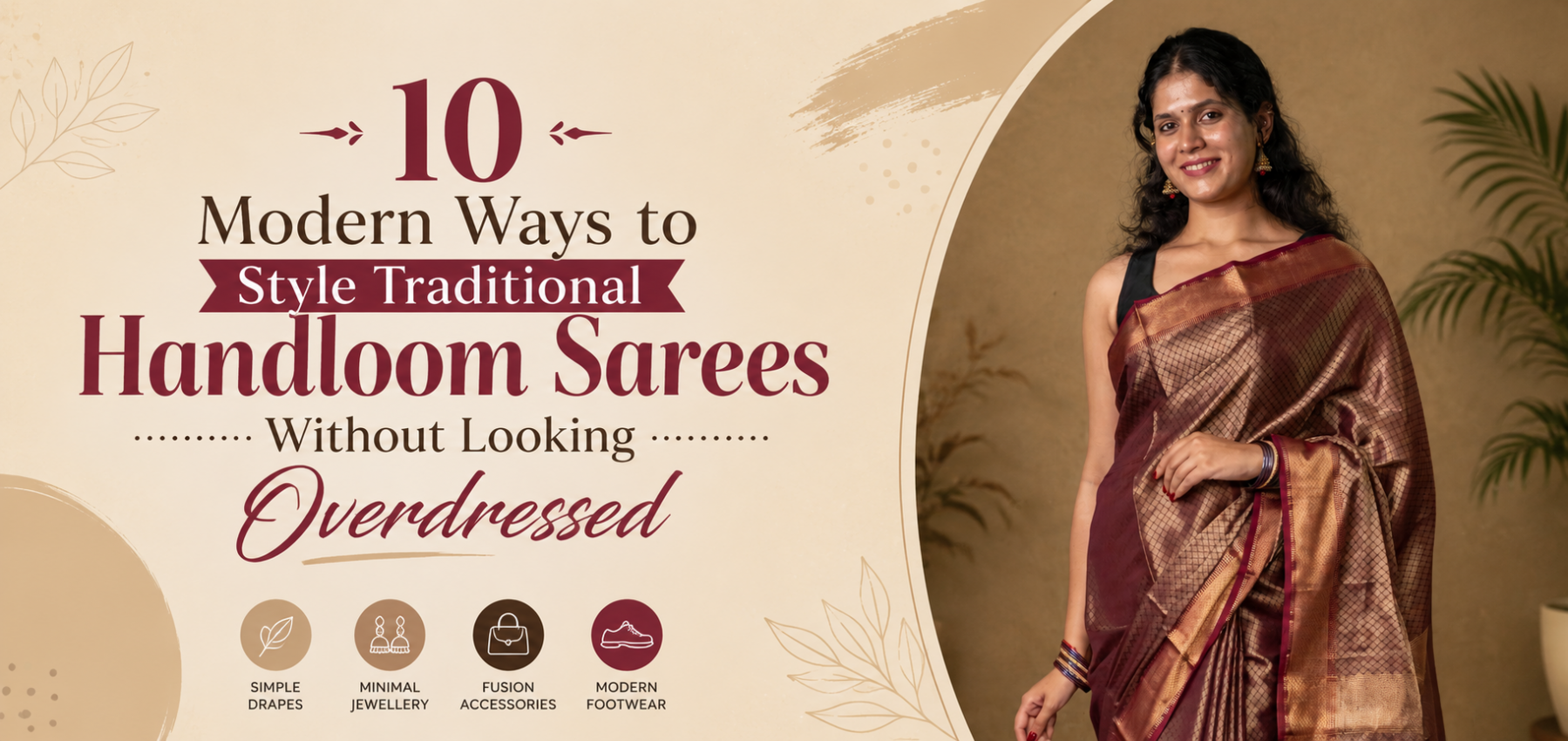
10 Modern Ways to Style Traditional Handloom Sarees Without Looking Overdressed
Quick answer: A handloom saree stops feeling "too much" the moment you simplify everything around it — one clean blouse silhouette, one statement accessory, an intentional pallu, and minimal makeup. Handwoven fabrics like Maheshwari silk, Chanderi, and hand-painted Batik cotton already carry texture and character on their own, so the styling job is to support the weave, not add to it.
The saree is having a quiet, steady comeback in Indian wardrobes — not as a once-a-year festive outfit, but as something women reach for on a Tuesday afternoon at work or a Saturday brunch with friends. Yet many women still hesitate before wearing one outside a wedding or puja, worried it will read as "too dressed up" for the room. The truth is, the saree was never the problem. It's almost always the styling around it — a blouse with too much detail, jewellery stacked three layers deep, or a drape that takes over the whole look. Handloom sarees, in particular, are woven with enough natural texture and individuality that they need far less added to them than most people assume.
Why Handloom Sarees Often End Up Looking "Too Much"
Most overdressed saree moments come from doubling up — a richly textured weave paired with a heavily embellished blouse, finished off with a full jewellery set and bold makeup. Each element is fine on its own, but stacked together, they compete for attention instead of working as one look. Handwoven fabrics like Chanderi, Maheshwari, and Batik already have woven motifs, reversible borders, or hand-painted patterns built in. The styling goal isn't to add more — it's to know what to leave out.
1. Choose a Blouse That Doesn't Compete With the Weave
If your saree already has texture — woven buttis, a contrast border, a subtle sheen — pair it with a clean, well-fitted blouse instead of an embroidered one. A boat neck, square neck, or a simple full-sleeve cut lets the fabric stay the focal point. Save the embellished blouse for plain, solid-colour drapes where it has room to stand out.
2. Let the Fabric Set the Mood, Not Fight It
Every handloom weave has a personality, and dressing with it — rather than against it — is the fastest route to looking effortless. A lightweight, breathable pure maheshwari silk saree already leans understated with its soft sheen and reversible border, so it needs almost no extra styling to look put-together for a day function or office event. Heavier silks with zari work, on the other hand, naturally read as festive and suit fewer, bolder accents instead of many small ones.
3. Treat the Pallu as a Styling Tool, Not an Afterthought
How you handle the pallu changes the entire formality of a look without touching the rest of the drape. A neatly pinned pallu at the shoulder feels tidy and office-appropriate. A loosely draped, slightly open pallu feels relaxed and weekend-ready. Before reaching for new accessories, try simply re-pinning the pallu — it's the quickest, lowest-effort styling change available.
4. Swap a Full Jewellery Set for One Statement Piece
This is the single biggest shift in modern saree styling: choosing one piece — a pair of statement earrings, a cuff, or a single layered necklace — instead of a matching three-piece set. Handwoven sarees, especially those with patterned borders or hand-painted motifs, already carry visual interest. Let the saree and one accessory share the spotlight instead of competing with three.
5. Add Structure With a Belt, Brooch, or Pin
A thin waist belt over the pleats, or a brooch pinning the pallu in place, gives a handloom saree a tailored, contemporary edge without changing the drape itself. This works particularly well with cotton and silk-cotton blends that hold a crisp shape, and it's an easy way to wear a saree to a smart-casual or semi-formal setting without it tipping into "ceremonial" territory.
6. Pair It With Footwear That Feels Current
Block heels, simple kolhapuris, or even clean sneakers under a cotton handloom saree instantly shift the mood from formal to everyday. Footwear is one of the most overlooked styling choices, yet it does a lot of quiet work in signalling whether an outfit feels like a costume or a comfortable, current choice.
7. Keep Hair and Makeup Deliberately Simple
A textured handloom saree doesn't need a full face of makeup or an elaborate hairstyle to feel complete. A low bun or soft waves, dewy skin, and a single bold element — a tinted lip or kohl-lined eyes — usually does more for the overall look than heavy contouring or an ornate updo. Simplicity here lets the saree remain the most interesting part of the outfit.
8. Let Hand-Painted Prints and Motifs Be the Statement
Hand block prints and resist-dyed weaves are naturally expressive, which means the rest of the outfit should stay quiet. Indian batik sarees are a good example — the wax-resist dyeing process creates patterns with slight, deliberate irregularities, and that artistry reads best against a plain blouse and minimal jewellery rather than additional prints or embellishment.
9. Mix Textures Instead of Stacking Layers
Modern styling often leans on layering — jackets, capes, or a second dupatta — but with handloom sarees, mixing two textures (say, a smooth silk-cotton saree with a slightly nubby cotton stole) often looks more current than adding another full layer. It keeps the silhouette light, which matters in Indian weather, while still giving the outfit visual depth.
10. Dress for the Room You're Walking Into
The most reliable way to avoid looking overdressed is matching saree weight to occasion. Cotton and silk-cotton blends suit the office, casual outings, and daytime events. Richer silks and tissue weaves make sense for weddings and festive evenings. A saree rarely looks "too much" when its weight, weave, and styling all match the setting it's being worn into.
A Quick Checklist Before You Step Out
- One statement accessory, not a full set
- A blouse silhouette that matches the saree's texture, not its occasion-status
- A pallu style that suits the formality of the event
- Makeup and hair kept lighter than you think you need
- Saree weight appropriate for the time of day and setting
Choosing Handloom Weaves That Are Easy to Style Often
Not every saree needs to be saved for special occasions. Lightweight, breathable weaves are the ones you'll actually reach for on a regular Tuesday, which makes them worth knowing well. Maheshwari silk sarees online are a dependable starting point — the silk-cotton blend keeps them light enough for long days, and the reversible border means less fuss while dressing. If you prefer something with more visual personality, batik cotton sarees bring artistic, hand-painted patterns that work well for daytime events without needing heavy styling around them. For those exploring options digitally, browsing batik print sarees online is a practical way to compare motifs, colourways, and weave weights before deciding what suits your wardrobe and your weather.
Authenticity matters here too. A genuine handwoven saree — whether Maheshwari, Chanderi, or a batik print cotton saree — will show small, natural variations in the weave or print. These aren't flaws; they're proof of a human hand at the loom or the wax-resist station, and they're part of why handloom sarees photograph and drape differently from mass-produced prints.
Final Thoughts
Looking overdressed in a saree is rarely about the saree itself — it's almost always about everything layered on top of it. Once you start treating the blouse, jewellery, pallu, and makeup as choices to simplify rather than elements to add to, even the richest handloom weave settles comfortably into office days, festive evenings, and everything in between. That's really what modern saree styling comes down to: trusting the craftsmanship already woven into the fabric, and styling around it with restraint rather than excess.
Frequently Asked Questions
1. How can I style a saree for everyday wear without looking too dressed up?
Choose a lightweight cotton or silk-cotton handloom saree, pair it with a simple, well-fitted blouse, and keep jewellery to one piece. A neatly pinned pallu and minimal makeup complete an everyday-appropriate look without extra effort.
2. Which handloom fabric is best for a modern, lightweight saree look?
Maheshwari silk and cotton-blend weaves are among the most practical choices — they're breathable, hold a clean drape, and work across long working days as easily as festive evenings.
3. What blouse styles work best with handwoven sarees?
Clean necklines like boat neck, square neck, or a fitted full-sleeve cut generally work best, since they let the saree's natural texture and border detailing stand out instead of competing with embellishment.
4. Can handloom sarees be worn for office or work settings?
Yes. Cotton, Chanderi, and Maheshwari weaves in muted or solid tones, paired with a structured blouse and minimal accessories, make handloom sarees practical and appropriate for most professional settings.
5. How do I keep accessories balanced when wearing a printed or textured saree?
Let the print or weave do most of the visual work. Stick to one accessory — statement earrings or a single necklace — rather than a full matching set, so the saree's detailing remains the focus.
-
Which Saree Should I Wear? Easy Choices for Weddings, Office, Festivals & Everyday
September 17th, 2026 -
 August 25th, 2026
 -
What to Wear for Ganesh Chaturthi: Saree Colours and Styling Guide
August 24th, 2026 -
 August 24th, 2026
 -
 August 19th, 2026