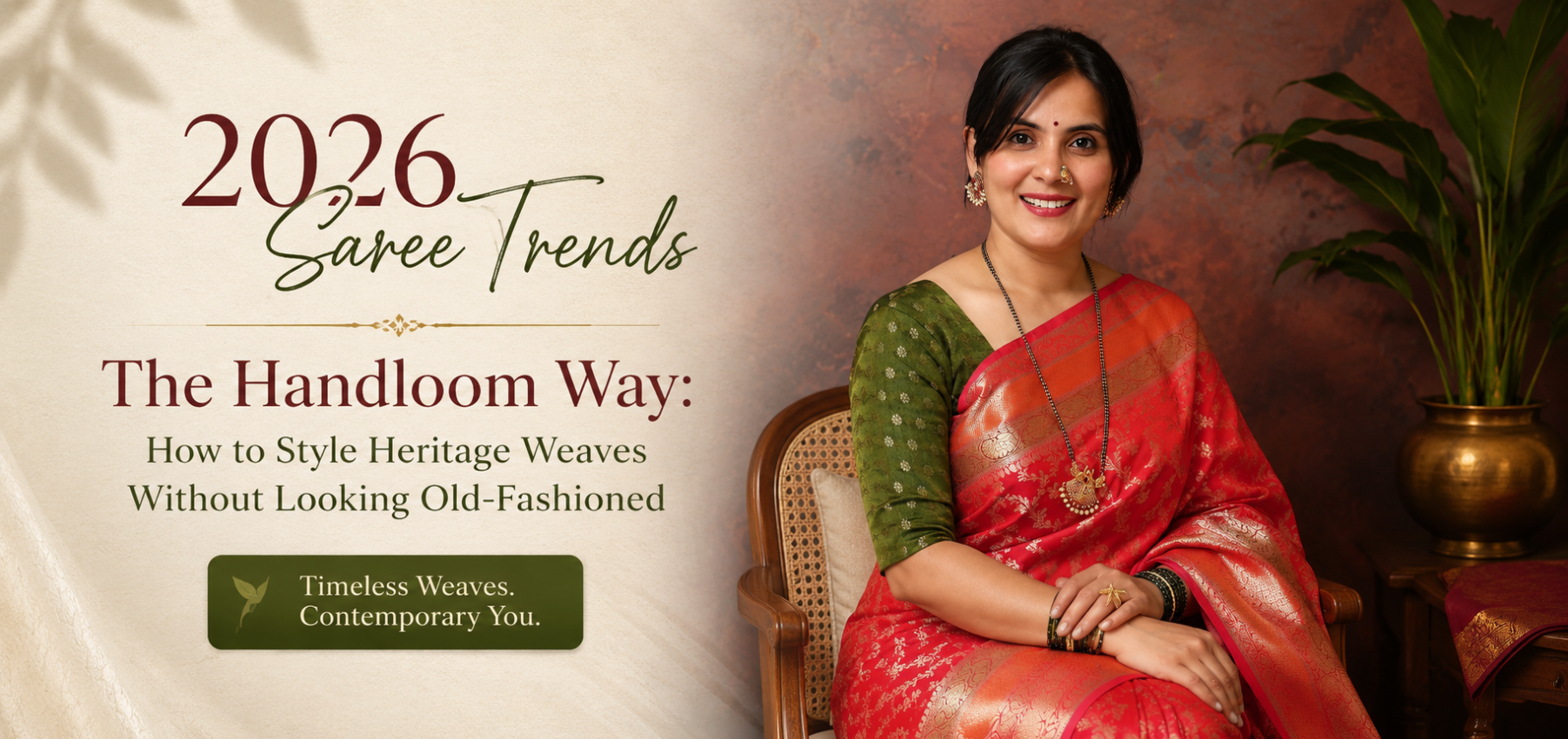
2026 Saree Trends, The Handloom Way: How to Style Heritage Weaves Without Looking Old-Fashioned
Walk into any wedding hall, office floor, or festive gathering across India this year, and one thing stands out: handloom is no longer the "special occasion only" piece pulled out of a grandmother's trunk. It has moved to the centre of how Indian women are dressing every day. Among everything shaping 2026 saree trends, the most interesting shift isn't a new print or a new blouse cut — it's a return to real fabric, real weave, and real craftsmanship, styled in a way that finally feels current.
The catch is that most women who own a handloom saree have, at some point, felt it look a little dated on them — not because the weave was wrong, but because the styling around it hadn't moved with the times. This guide breaks down exactly which heritage weaves are worth investing in this year, and more importantly, how to wear them so they read as intentional and modern, not borrowed from another decade.
Why Handloom Is Leading the Conversation This Year
Three things are driving this shift at once. First, shoppers are increasingly aware of what powerloom and machine-printed sarees can't offer — texture, depth, and the subtle irregularities that come only from a human hand on a loom. Second, slow fashion has stopped being a niche preference and become a mainstream expectation, with more buyers actively choosing pieces that support weaver communities over mass production. Third, social media has made craftsmanship visible in a way it never was before — a hand-block print or a zari border now gets the same admiration online that a designer label used to get.
Together, these shifts mean heritage weaves aren't being worn out of obligation anymore. They're being chosen because they genuinely look better in photographs, drape better in person, and last longer in a wardrobe than fast-fashion alternatives.
What Actually Makes a Saree Feel Old-Fashioned (It's Rarely the Fabric)
Here's the part most styling advice gets wrong: a handloom saree rarely looks dated because of its weave. It looks dated because of three very fixable habits — over-pleating that hides the fabric's natural fall, jewellery stacked without restraint, and a blouse that was chosen as an afterthought rather than as the actual anchor of the look. Change those three things, and the same nine yards that felt "too traditional" suddenly reads as deliberate and current.
The Heritage Weaves Worth Knowing Before You Shop
Chanderi: Sheer, Lightweight, and Endlessly Photogenic
Woven in Chanderi, Madhya Pradesh, using a fine cotton warp and silk weft, this fabric is known for its translucent texture and soft sheen — qualities that read as effortless rather than heavy, even when the work is intricate. A chanderi silk saree with zari border in particular strikes a balance most fabrics can't: enough shine for an evening event, enough lightness for a daytime one.
Maheshwari: The Reversible Classic Every Wardrobe Needs
Handwoven on the banks of the Narmada, Maheshwari silk is recognisable by its distinctive reversible border — a detail that lets the same saree be styled two different ways depending on how it's draped. A pure maheshwari silk saree tends to sit beautifully on most body types because the weave has just enough body to hold a clean pleat without stiffness.
Batik: Wax-Resist Art That Reads Completely Contemporary
Batik is one of the oldest dyeing techniques in the world, made by applying hot wax by hand and dyeing the fabric in layers, so the pattern that emerges is never fully repeatable. That unpredictability is exactly why indian batik sarees have found a new audience among younger buyers — the irregular, organic motifs look closer to contemporary art than to "ethnic print," which is part of why they pair so naturally with minimal, modern styling.
How to Style Heritage Weaves So They Look Current, Not Costume-Like
Start With the Blouse, Not the Saree
The single biggest update you can make is choosing the blouse first and letting it set the tone. A structured high-neck blouse instantly modernises a traditional weave. A well-fitted sweetheart neckline softens it for daytime. The mistake to avoid is defaulting to a plain, loose blouse simply because the saree already has "enough going on" — a deliberate blouse choice is what separates a styled look from an inherited one.
Rework the Pleats and the Pallu
Tighter, fewer pleats with a clean pin at the waist look noticeably more current than the traditional wide, loose pleat count. For the pallu, try pinning it diagonally across one shoulder instead of letting it fall loose — it's a small change that immediately reads as more put-together.
Let One Element Lead — Not Everything at Once
Heritage weaves already carry visual weight in their border, motif, or zari work. The most common dating mistake is adding heavy jewellery on top of all of it. Pick one focal point — a statement border, bold earrings, or a sculptural neckpiece — and keep everything else minimal.
Pair Smart With Footwear and Hair
Block heels or structured juttis work better with handloom drapes than delicate strappy sandals, since the saree itself already carries texture. For hair, a sleek low bun or soft waves photograph better than heavily set traditional hairstyles, which can unintentionally age the entire look.
Styling Heritage Weaves by Occasion
Workdays: A lightweight cotton or Chanderi saree with a structured blouse and a single statement accessory works for back-to-back meetings without feeling formal.
Festive gatherings: This is where a richer weave earns its place — silk and tissue textures hold their own next to brighter colours and slightly bolder blouse choices.
Wedding guest appearances: Look for pieces with a defined border or pallu detail, since these photograph well without needing extra embellishment elsewhere. Anyone exploring maheshwari silk sarees online for this purpose should prioritise drape and border weight over print, since that's what actually shows up in photographs.
Everyday wear: Soft cotton handloom, styled simply with juttis and minimal jewellery, holds up to daily movement far better than synthetic alternatives while still looking deliberate.
Building a Capsule Wardrobe Around Heritage Weaves
You don't need ten sarees to stay current with 2026 saree trends — you need three or four versatile heritage pieces that cover every occasion above. A good starting capsule typically includes one cotton weave for daily wear, one silk weave for festive use, and one printed or textured piece for variety. For the third category, Batik cotton sarees are a smart pick, since the hand-dyed motifs read as intentional rather than busy and pair easily with both ethnic and fusion blouses.
Mistakes That Quietly Date a Handloom Saree
- Skipping the inner draft pin: Pleats that aren't pinned at the waist tend to droop over a few hours and lose their clean shape in photos.
- Over-matching everything: Jewellery, bindi, and bag in the exact same metal tone as the saree's border reads as costume styling rather than fashion styling.
- Ironing the wrong way: Pressing directly on zari or block-printed sections can flatten or dull the work — always iron from the reverse side, on a low setting, with a cloth in between.
- Choosing fabric weight by occasion alone, not season: A heavy silk in peak Indian summer fights the body instead of flattering it, regardless of how festive the event is.
Why Authentic Handloom Outperforms Mass-Produced "Trend" Sarees
Trend-driven, factory-printed sarees are designed to look current for a single season and then date quickly, because their appeal is tied entirely to a passing print or colour. Genuine handloom pieces work differently — the craftsmanship itself doesn't expire, which is why a well-chosen weave from a decade ago can still be restyled to look completely current today. This is also why authenticity matters at the point of purchase: a hand-applied wax pattern, like the kind found on a batik print cotton saree, will show small, natural variations from piece to piece, while a printed imitation repeats its pattern identically across the bolt. Once you know what to look for, the difference is easy to spot — and it's the difference between a saree that dates and one that doesn't.
Frequently Asked Questions
1. What are the biggest saree trends for 2026?
This year's direction favours authentic handloom weaves — Chanderi, Maheshwari, and Batik among them — styled with structured blouses, minimal jewellery, and cleaner pleats, rather than heavily embellished or printed alternatives.
2. How do I style a traditional saree so it doesn't look outdated?
Focus on three changes: choose a modern blouse silhouette first, keep pleats tight and pinned, and let only one element — border, jewellery, or blouse — carry the statement instead of layering everything at once.
3. Which handloom fabric is best for everyday wear versus festive occasions?
Cotton weaves like Maheshwari cotton or Batik cotton suit daily wear and office use due to their breathability, while silk and tissue weaves are better suited to festive and wedding occasions where more drama and shine are appropriate.
4. How can I tell if a saree is genuinely handwoven and not machine-made?
Genuine handloom fabric shows slight, natural irregularities in the weave or border — these aren't flaws, they're proof of a human hand on the loom. Machine-made or printed versions tend to repeat patterns identically and feel uniformly stiff.
5. Are handloom sarees a good long-term investment compared to trendy printed sarees?
Yes. Handloom sarees don't lose relevance the way printed, trend-led pieces do, since their value comes from craftsmanship rather than a passing print or colour. With proper care, a good heritage weave can be restyled for years.
-
Which Saree Should I Wear? Easy Choices for Weddings, Office, Festivals & Everyday
September 17th, 2026 -
 August 25th, 2026
 -
What to Wear for Ganesh Chaturthi: Saree Colours and Styling Guide
August 24th, 2026 -
 August 24th, 2026